
- There are no more items in your cart
- Shipping
- Total 0.00 zł



- Bestsellers
- Wholesale
- Water filters
- Whole house filters
- Kitchen filters
- Bathroom filters
- Aquarium filters
- Reverse osmosis
- Water demineralizers
- Filter cartridges
- UV bactericidal lamps
- Alkaline water ionizers
- Industrial water filters
- Accessories, parts, and others
- Descaling filters for the coffee machine
- Water softeners and iron removers
- Water saturators
- ACES
- AMBERLITE
- AQUA VITA
- AQUAFILTER
- AQUAPHOR
- AQUATOR
- BASSAU
- BERG
- BIOCERA
- BIONIQ
- BLUEFILTERS
- CHEMOFORM
- CINTROPUR
- DAFI
- DELONGHI
- DIAMOND
- DOM WODY
- ECOWATER
- FILMTEC
- FIT ALCO
- FITAQUA
- GREEN FILTER
- HANNA INSTRUMENTS
- HELIXPRO
- HELLO PURE
- HIDROTEK
- HM-DIGITAL
- HONEYWELL
- Ibo
- JAVEL
- KLARWOD
- KRUPS
- MIDEA
- OTOWODA
- OTTONE
- Palintest
- PENTAIR
- PHILIPS
- PLATINUM WASSER
- PUROLITE
- SIEMENS
- Steingraf
- SUPREME
- TAB-SOL
- TOP FILTER
- UST-M
- USTM
- VONTRON
- WODARO
-
PayU

Tips
-
The water in the osmosis system is constantly flowing to the sewage - what to do?
-
Hydrogen water – effects, benefits, reviews – is it a scam?
-
Reverse osmosis - operating costs
-
Elimination of chlorine from water – why is it worth doing?
-
Pesticides in water - what they are, health risks, how to remove them
-
The water in the osmosis system is constantly flowing to the sewage - what to do?
-
Organic compounds in water – harmfulness, removal, and where do they come from?
-
Ammonia in water – where does it come from, is it harmful, and how to remove it?
-
Water filtration - why? Hit or miss?
-
Drinking water - effects after a month, skin and weight loss
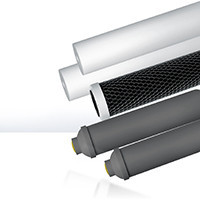
Water filter insert sets
Choosing the right set of water filtration inserts is one of the most important elements of the daily operation of a filtration system. A well-selected set supports obtaining cleaner, safer, and better-tasting drinking water for the whole family.
Depending on the water source and individual needs, different types of inserts are used: from simple mechanical filters that trap larger contaminants to more advanced solutions, such as reverse osmosis systems that remove bacteria, viruses, and very fine particles. Each element of the set plays a specific role in the filtration process.
Filter
Price
Brand
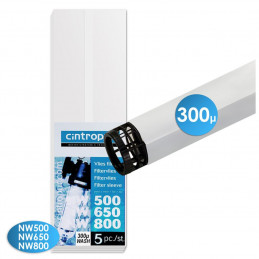
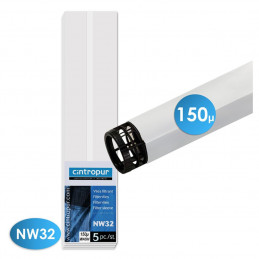
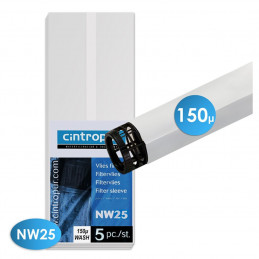
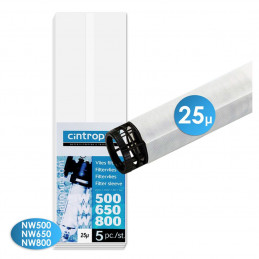
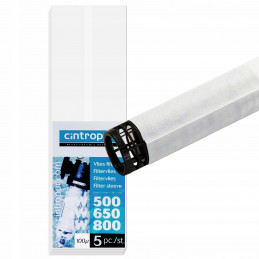
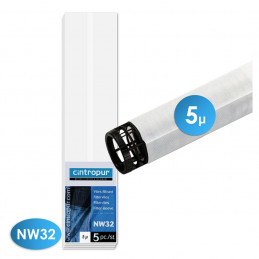
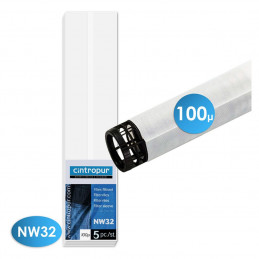
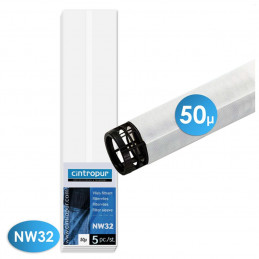
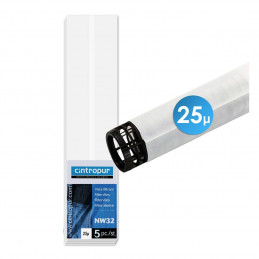
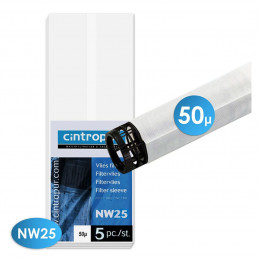
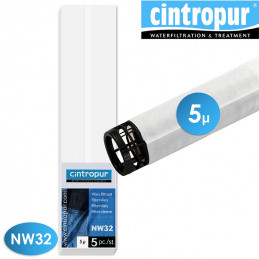
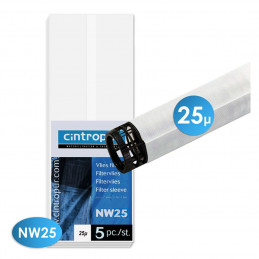
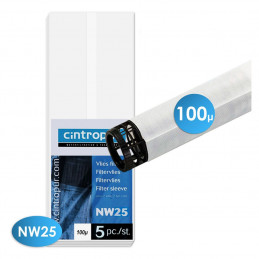
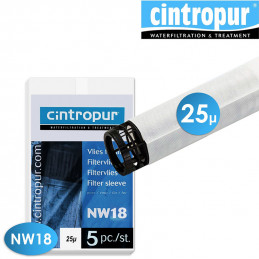
NW18 Cintropur filter insert 25 microns
Filtration insert sets are a practical solution for users who want to conveniently choose a complete set of consumable components for their water treatment system. This category includes inserts designed for various stages of filtration — from the initial removal of sediment, through improving taste and odor, to precise water purification in more advanced systems.
In this category, you will find water filter insert sets tailored to various needs: mechanical, carbon, osmotic, capillary, mineralizing, ionizing, ceramic, softening, iron-removing, demineralizing, reusable, and inline sediment inserts. Solutions are also available in popular sizes such as 10", 20", 30", and larger, as well as 10" Big Blue and 20" Big Blue.
Why choose a ready-made insert set?
A ready-made set makes regular replacement of filtration components easier and helps keep the system in proper condition. It is a convenient option for both household filters and more demanding applications.
- Easier selection — sets are prepared for specific applications and filtration stages.
- Convenient operation — you replace the complete set of inserts in one service cycle.
- Better filtration organization — each insert is responsible for a specific type of contamination.
- Support for water quality — it is possible to simultaneously remove sediment, chemical contaminants, and improve the functional parameters of water.
- Adaptation to the system — various types and sizes of inserts are available for many filtration systems.
Types of water filter inserts
String-wound insert
Also known as a mechanical filter. It effectively traps larger contamination particles such as sand, silt, or sediment. It is easy to install and very often constitutes the first stage in multi-stage filtration systems.
Foam inserts
They are effective in removing finer contamination particles thanks to a larger filtration surface. They work well where water contains minor mechanical impurities.
Carbon insert
Removes chemical contaminants, improves the taste and odor of water, and helps eliminate unpleasant smells and aftertastes. It is a good choice for households struggling with chlorine or pesticides in water.
Osmotic membranes and capillary membranes
They provide a very high level of water purification by removing bacteria and fine particles. They filter water down to 0.0001 micron, which is why they are especially important where water quality is poor.
Mineralizing inserts
They add minerals such as calcium and magnesium to the water. They are chosen by people who want to improve the quality of their drinking water after the precise filtration process.
Ionizing inserts
They change the pH of water, making it more alkaline. They are recommended for users looking for water with specific pH properties.
Ceramic inserts
The highly porous structure enables the removal of bacteria and microorganisms. Such inserts are used where there is a risk of biological contamination of water.
Softening inserts
They remove excess calcium and magnesium, which helps reduce limescale buildup. They are especially important in regions with hard water.
Iron-removing inserts
They effectively reduce excess iron and manganese. This is an important filtration element in areas where the concentration of these metals in water is elevated.
Demineralizing inserts
They remove almost all minerals from water. They are used in specialized industrial and laboratory applications, as well as, among others, in aquarium water filtration sets.
Reusable inserts
For example, mesh inserts or rinseable ones. They can be cleaned and reused, making them an economical and eco-friendly solution while also being inexpensive to maintain.
Inline sediment inserts
They remove sediment and larger contamination particles. They are used as a pre-filtration stage in more advanced water treatment systems.
How to choose an insert set for your needs?
The choice of set should result from the type of system, water quality, and the expected filtration effect. Different solutions work well for sediment issues, others for chlorine, and still others for hard water or the risk of biological contamination.
- For mechanical contamination, it is worth paying attention to string-wound, foam, and inline sediment inserts.
- For taste and odor issues, carbon inserts are a good choice.
- For very high water purity requirements, osmotic and capillary membranes are used.
- For hard water, softening inserts are helpful.
- For elevated iron and manganese levels, it is worth considering iron-removing inserts.
- If you care about specific water properties, mineralizing or ionizing inserts can be included.
In practice, the best results come from matching the set not only to the filter type, but also to the actual problems present in the water. Regular replacement of inserts has a direct impact on filtration effectiveness and system usability.
Classification of sets by size
Insert size affects filtration capacity, flow rate, and replacement frequency. In this category, several of the most commonly used formats can be found.
| Size / type | Application and characteristics |
|---|---|
| 10-inch | A standard size for many household filtration systems, providing a good balance between dimensions and filtration efficiency. |
| 20-inch | Longer inserts, suitable for higher water consumption and light commercial applications. |
| 30-inch and larger | Most often used in industrial filtration systems, where handling large quantities of water and less frequent insert replacement matter. |
| 10-inch Big Blue | Wider than standard 10-inch inserts, they offer greater water flow and more effective contaminant retention at higher usage. |
| 20-inch Big Blue | They combine a large diameter with greater length, which translates into longer service life and longer intervals between replacements. |
What should you pay attention to before buying?
- Check what type of inserts your filter or treatment system supports.
- Compare insert size: 10", 20", 30", or Big Blue versions.
- Determine whether you need mechanical, carbon, softening, iron-removing, or osmotic filtration.
- Consider whether you also want mineralization or a change in water pH.
- For intensive use, consider larger sizes that allow more water to be filtered.
- If you want lower maintenance costs, check reusable inserts.
FAQ
What is included in the insert sets category?
The category includes water filter insert sets intended for various filtration stages, including mechanical, carbon, osmotic, capillary, mineralizing, ionizing, ceramic, softening, iron-removing, demineralizing, reusable, and inline sediment inserts.
Which inserts work well for sand, silt, and sediment?
For removing larger mechanical contaminants, string-wound and inline sediment inserts are most commonly used. For finer particles, foam inserts also work well.
Which type of insert improves the taste and odor of water?
Carbon inserts are primarily responsible for improving the taste and odor of water. They also help reduce the presence of unpleasant odors and chemical contaminants such as chlorine.
What are osmotic and capillary membranes used for?
Osmotic and capillary membranes are used for very precise water purification. They remove bacteria and very fine particles, and the filtration level can reach up to 0.0001 micron.
When is it worth choosing softening inserts?
Softening inserts are worth using where the water is hard and causes limescale buildup. They help remove excess calcium and magnesium.
What is the significance of insert size?
Insert size affects the amount of filtered water, flow rate, and replacement frequency. 10-inch inserts are popular in homes, 20-inch inserts work well for higher usage, and larger formats and Big Blue are chosen for more demanding applications.
How do standard inserts differ from Big Blue?
Big Blue inserts are wider than standard counterparts, which means they offer greater water flow and can work more effectively in systems with higher demand.
Are reusable inserts available?
Yes, this group also includes reusable inserts, for example mesh ones or those intended for rinsing. They can be cleaned and reused, which reduces operating costs.
What are mineralizing and ionizing inserts used for?
Mineralizing inserts enrich water with minerals such as calcium and magnesium. Ionizing inserts change the pH of water, making it more alkaline.
When are iron-removing and demineralizing inserts used?
Iron-removing inserts are used when water has elevated levels of iron and manganese. Demineralizing inserts are used where water deprived of almost all minerals is needed, including in selected industrial, laboratory, and aquarium applications.