
- There are no more items in your cart
- Shipping
- Total 0.00 zł



Ammonia in water – where does it come from, is it harmful, and how to remove it?
The presence of ammonia in water is a problem that often reveals an unpleasant odor or specific aftertaste, but the threat goes deeper than just sensory discomfort. Although it rarely causes acute poisoning in humans at the concentrations found in wells, it is a signal of serious contamination and a precursor to harmful nitrites. In this article, we explain how to effectively diagnose the problem and choose a filtration method.
Table of contents
- What is ammonia and why does it end up in water?
- Is ammonia in water harmful to health?
- How to recognize the problem? Smell and diagnostics
- Ammonia in well water and legal standards
- How to get rid ofammonia? Effective methods
- Common mistakes and pitfalls
- Frequently Asked Questions (FAQ)
In this article, you will learn:
- Why ammonia in drinking water is dangerous indirectly, transforming into carcinogenic compounds.
- How to distinguish the smellammonia from hydrogen sulfide and what the water test results indicate.
- When is a reverse osmosis filter sufficient, and when is a system needed for the entire installation.
- What are the permissible standards for ammonium ion concentration in Poland.
What is ammonia and why does it end up in water?
Ammonia (chemical formula NH3) is an inorganic compound of nitrogen and hydrogen. Under natural conditionsis formed in the process of anaerobic decomposition of organic matter – both plant and animal. In water, it most commonly occurs in the form of ammonium ion NH4, and the ratio between the gaseous and ionic forms mainly depends on the pH of the water.
Why does ammonia dissolve so well in water? This is due to its polar structure and its ability to form hydrogen bonds with water molecules.makes it very mobile in the ground and easily penetrates into aquifers. The main reasons for its presence in water intakes are:
- Agricultural pollutants: runoff from fields fertilized with manure or synthetic fertilizers.
- Leaky septic tanks: seepage of household wastewater into groundwater (a common problem in densely built single-family housing).
- Natural processes: reduction of nitrates in deeper soil layers in the absence of oxygen (typical for deep wells).
Key thought: The presence of ammonia in a shallow dug well is almost always a signal that sewage or fertilizers are entering the water. This requires immediate action.
Is ammonia in water harmful tohealth?
One of the most common questions is: is ammonia harmful and is water containing it toxic? The short answer is: ammonia itself, at concentrations found in drinking water, usually does not cause immediate, acute poisoning in humans (unlike fish, for which it is lethal). However, its presence triggers a chain of dangerous reactions.
The main threats arising from the presenceammonia:
- Formation of nitrites: In water installations, ammonia undergoes the nitrification process. Bacteria convert it into nitrites, which are very dangerous, especially for infants (they can cause cyanosis, meaning the blockage of oxygen transport in the blood).
- Reduction of disinfection effectiveness: Ammonia reacts with chlorine, forming chloramines.It consumes a dose of chlorine, which makes the water less disinfected and more susceptible to the development of bacteria.
- Taste and odor problem: Even if the concentration is not toxic, the water becomes unacceptable for consumption due to organoleptic reasons.
Therefore, answering the question "is ammonia harmful to health" – yes, it poses a serious threat indirectly.and it must be removed without exception, especially if the water is intended for children.

How to recognize the problem? Smell and diagnostics
A high concentration reveals a specific smell of ammonia. What does ammonia smell like? It is sharp, biting, irritating to the nostrils – reminiscent of the smell of spoiled urine or strong cleaning agents.However, in well water, it often occurs in lower concentrations that do not produce such drastic olfactory symptoms, yet still exceed the norms.
Quick diagnostic checklist:
- Smell: Does the water have a slightly musty, rotten, or chemical smell?
- Turbidity: Ammonia often accompanies turbid, contaminated water.organically.
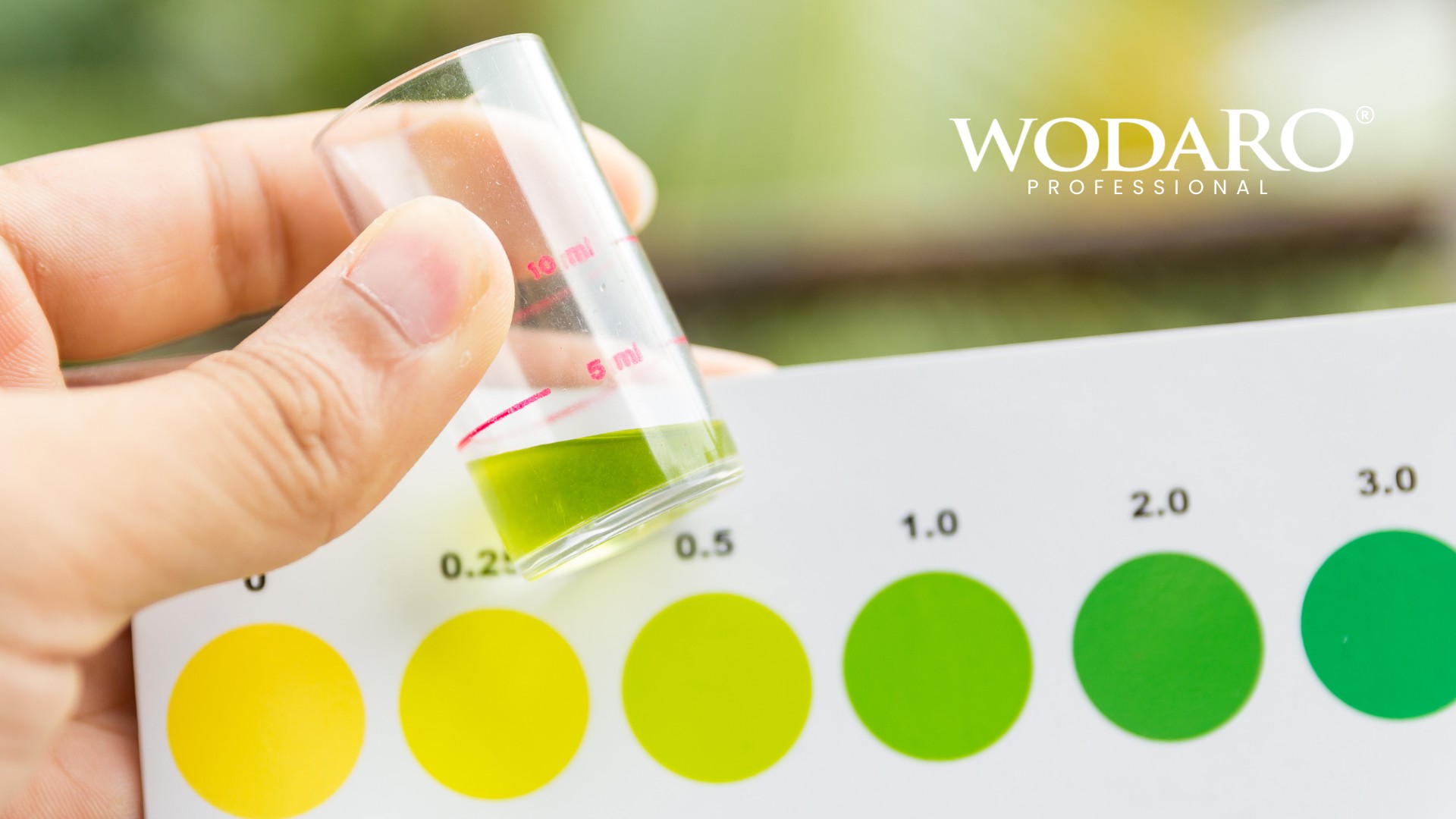
- Test result: Look at the "Ammonium ion" parameter in the physicochemical analysis.
To be sure, perform a professional water analysis at the Sanitary-Epidemiological Station or an accredited laboratory. Home test strips can only be indicators, but when selecting devices, we need a precise result in mg/l.
Ammonia in well water and legal standards
In Poland, the quality of water intended for consumption is regulated by the Regulation of the Minister of Health. Ammonia in drinking water is strictly limited. The permissible concentration of ammonium ion is 0.50 mg/l.
In the case of ammonia in private well water, we often encounter exceedances of the order of1.5–3.0 mg/l, and in extreme cases even more. It is important to know that ammonia often goes hand in hand with elevated iron and manganese levels. These contaminants tend to occur together in anaerobic environments.
Important: If your water is chlorinated (e.g., from the municipal supply), and you notice a strange, chemical smell (different from pure chlorine), it could be chloramines – a result of the reaction between chlorine and ammonia that was not removed during the treatment process.
How to get rid of ammonia? Effective methods
When considering how to get rid of ammonia, we must take into account other water parameters such as hardness, iron, and pH. A single carbon filter is usually not sufficient for continuous water supply for the entire house. Here are proven selection scenarios:
1. Multifunctional stations (Ion exchange)
This is the most effective method for homes.single-family. Special multifunctional media (e.g., Ecomix-type mixtures) simultaneously remove hardness, iron, manganese, and ammonia. They operate on the principle of ion exchange – ammonium ions are "captured" by the media and then flushed into the sewage system during regeneration with salt.
When to choose: When you have elevated ammonia, hard water, and iron/manganese. This is a comprehensive solution.
2.Reverse osmosis (For drinking in the kitchen)
If the problem concerns only drinking and cooking water, and the tap water is "technically" acceptable, the reverse osmosis system will remove ammonia by over 95%. The osmotic membrane is an almost impenetrable barrier for ammonium ions.
When to choose: When you want crystal clear water in the kitchen, regardless of the condition of the installation inhome.
3. Chlorination to the breakpoint (Industrial method)
Involves adding a large amount of chlorine, which oxidizes ammonia to free nitrogen. This method is difficult to control in home conditions and is rarely recommended for individual customers due to the formation of by-products.
Do you have a problem with ammonia and don't know which method to choose? SelectionThe deposits depend on precise water testing results. Check our multifunctional stations or contact us for a free consultation.
Common mistakes and pitfalls
Removing ammonia is not as simple as removing scale. Here’s a list of things to watch out for:
- IgnoringpH: Some methods (e.g., aeration) are ineffective at low pH because ammonia remains in ionic form and does not want to "evaporate."
- Use of regular softeners: Standard softening resin has some ability to remove ammonia, but it is limited. At high concentrations, dedicated zeolite media (e.g., Crystal Right) are needed.
- Lackdisinfection: Removing ammonia is one thing, but if its source is a leaking septic tank, there may also be E.coli bacteria in the water. Always test the water microbiologically!
- Confusing odors: Customers often confuse the smell of hydrogen sulfide ("rotten eggs") with ammonia. The methods for removing these gases are different.
Frequently Asked Questions (FAQ)
Does boiling water remove ammonia?
Boiling water can help volatilize some ammonia (especially at higher pH), but it is an inefficient process and does not completely solve the problem. Additionally, boiling concentrates other contaminants in the water. It is not a recommended method of water treatment.
What are the symptoms of ammonia poisoning from water?
At tap water concentrations, acute poisoning is rare.likely. However, ammonia poisoning symptoms (in the case of inhaling fumes or ingesting very high concentrations) include burning in the throat, coughing, shortness of breath, abdominal pain, and vomiting. Long-term consumption of water with ammonia burdens the liver and kidneys and promotes the formation of carcinogenic nitrosamines.
Is ammonia toxic to pets?
Yes, especially for aquarium fish – for them evenTrace amounts are deadly. For dogs and cats, water with ammonia is harmful just like for humans and can cause digestive problems.
Is ammonia and ammonium ion the same thing?
In common language, these terms are used interchangeably. Chemically, ammonia is a gas (NH3), while the ammonium ion (NH4+) is the form dissolved in water. In water testing, the ammonium ion is usually measured, as it dominates at typical drinking water pH levels.
How much does it cost to remove ammonia from water?
The cost depends on the technology. A good water treatment plant of the multifunctional type costs around 3000-5000 PLN, but it solves the problem comprehensively for years. The operating cost is similar to that of tablet salt and water for rinsing.
Why does ammonia dissolve so well in water?
Ammonia is a dipole, which means, that it has an uneven charge distribution, similar to water. This allows it to form strong hydrogen bonds with water. Its solubility is one of the highest among gases – in 1 volume of water, several hundred volumes of ammonia can be dissolved.
Sources:
- https://isap.sejm.gov.pl/isap.nsf/DocDetails.xsp?id=WDU20170002294 - Regulation of the Minister of Health on the quality of water intended for human consumption(norms for ammonium ion).
- https://www.who.int/publications/i/item/9789241549950 - Guidelines for drinking-water quality (WHO) - information about ammonia in water.
- https://www.gov.pl/web/wsse-krakow/woda-do-spozycia - Information from the Provincial Sanitary-Epidemiological Station about water parameters.
Author: MaciejWaliduda - Water treatment technology specialist with many years of experience in selecting filtration stations for industry and single-family homes.
Last updated: 2026-02-10.
