Water treatment tailored to water parameters and application
Water treatment covers processes that change selected water parameters and prepare the water for a specific use in a home, business, agricultural property or industrial facility. Depending on the test results and the required outcome, a system can reduce hardness, iron, manganese, nitrates, unwanted taste and odour, or correct the pH level.
There is no single device suitable for every installation. Hard mains water requires a different solution from well water with elevated iron and manganese, while water with several problematic parameters may require a combined system. The choice of a water treatment system should therefore be based on the type of problem, the water source, consumption and the required peak flow rate.
Before choosing a system: for well water, an up-to-date laboratory analysis is the basis of correct selection. For mains water, it is worth knowing at least the hardness and the parameter responsible for the problem. The appearance, taste or odour of the water alone is not sufficient to select the right equipment.
What problems can a water treatment system solve?
Water treatment equipment should be selected for specific parameters, not only for the number of people in the building. A properly designed system can help address problems such as:
- hard water and limescale on fittings, shower glass, heating elements and household appliances,
- elevated iron or manganese, which may cause staining, deposits and a metallic taste,
- several problematic parameters at the same time, requiring a multifunctional system or a combination of treatment stages,
- unwanted taste and odour or selected substances that can be adsorbed by activated carbon,
- low pH, requiring a correctly selected neutralising medium,
- elevated nitrate levels, requiring dedicated equipment and a suitable treatment medium.
The treatment result depends on the correct technology, system capacity and operating conditions. When treated water is intended for drinking, it is advisable to confirm the achieved parameters with a follow-up water test after the system has been commissioned.
Types of water treatment equipment
Water softeners – hardness reduction
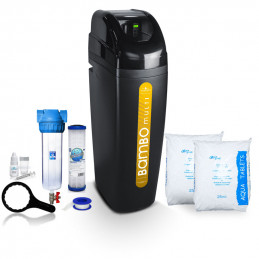
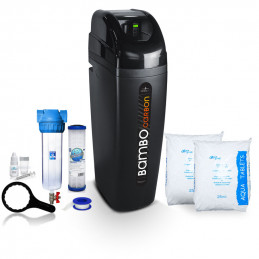
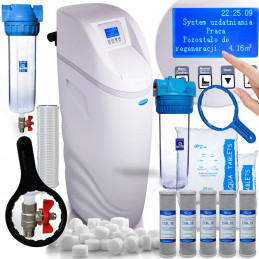
Water softeners use ion exchange to reduce hardness. Calcium and magnesium ions are exchanged for sodium ions, which helps limit limescale formation in pipework, fittings, boilers, water heaters, washing machines and dishwashers. The size of a softener should be selected primarily according to hardness, water consumption and the required flow rate.
Iron and manganese removal systems – treatment of well water
Iron removal systems are designed to reduce iron, while correctly configured systems may also reduce manganese. The treatment method depends, among other things, on the concentration and form of the contaminants, pH, turbidity, aeration conditions and the required capacity. An iron filter should therefore not be selected solely on the basis of rusty stains or the colour of the water.
Multifunctional systems – several processes in one unit
Multifunctional treatment systems use media designed to reduce several unwanted parameters at the same time. Depending on the model and the medium used, they can combine softening with the reduction of iron, manganese, ammonium or selected substances affecting taste and odour. Their use should always remain within the operating range of the particular treatment medium.
Whole-house carbon filters – taste, odour and selected compounds
Whole-house carbon filter systems provide central water treatment using activated carbon. They can improve taste and odour and reduce chlorine and selected compounds adsorbed on the surface of the medium. A carbon system is not a universal solution and does not replace a water softener, iron removal system or water disinfection.
pH correction and nitrate removal systems
When testing shows that the pH is too low, a water pH correction system may be appropriate. Elevated nitrate levels require dedicated equipment using a suitable medium – see our nitrate removal systems. In both cases, selection should take account of the complete water composition, flow rate and the conditions required for regeneration or media replenishment.
Electronic anti-scale systems
Electronic anti-scale systems are intended for installations where the aim is to limit scale deposition without using salt or ion-exchange regeneration. They do not remove calcium and magnesium ions from the water, so they should not be treated as an equivalent to a conventional water softener.
Comparison of the main solutions
| Problem or requirement |
Solution most often considered |
What should be checked before selection? |
| Hard water and limescale |
Water softener or anti-scale system |
Hardness, water consumption, peak flow rate and the expected result |
| Iron or manganese |
Iron removal system, manganese removal system or multifunctional unit |
Iron, manganese, pH, turbidity, other parameters and hydraulic conditions |
| Several problems at the same time |
Multifunctional system or a multi-stage treatment arrangement |
Complete water analysis, media operating range, consumption and required capacity |
| Unwanted taste or odour |
Whole-house carbon filter or another technology selected for the cause |
Source of the problem, water composition, required flow and the need for pretreatment |
| Low pH |
pH correction system |
pH, alkalinity, hardness and complete water composition |
| Elevated nitrate levels |
Nitrate removal system |
Nitrate concentration, consumption, flow rate and regeneration conditions |
Treatment of mains water and well water
Mains water
In properties supplied from the public water network, the most common objectives are to reduce hardness, limescale, chlorine taste or odour. Information from the water supplier and a measurement taken at the point of use provide the starting point, because the actual parameters affect the required system capacity and configuration.
Well water
For a private water source, selection should begin with an up-to-date physicochemical analysis and, when the water is intended for drinking, an assessment of microbiological parameters as well. Relevant values may include hardness, iron, manganese, pH, ammonium, nitrates and turbidity. Only by combining the test results with water consumption and the technical conditions of the installation is it possible to plan a single treatment unit or a multi-stage system.
Tip: yellow water, a metallic taste, black deposits or an unpleasant odour do not point conclusively to one treatment technology. Similar symptoms may result from different water parameters, so it is worth confirming the cause by testing before purchasing equipment.
How should a water treatment system be selected?
Correct selection is not simply a matter of choosing the largest model. The equipment should provide the required flow, operate correctly at the available pressure and regenerate under the conditions provided by the installation. Before purchasing, consider:
- water test results and the parameters that actually need to be changed,
- water source – public water supply, borehole, well or another source,
- daily and monthly consumption and the number of users,
- peak flow rate, meaning demand when several outlets are used at the same time,
- pressure, connection sizes and source capacity,
- installation space, access to electricity, drainage and sufficient service clearance,
- regeneration, backwashing and ongoing operating requirements,
- the need for pretreatment or further treatment stages.
When comparing systems, consider not only the purchase price but also the cost of salt, water used during regeneration, electricity, consumables, periodic media replacement and servicing.
Filter media and consumables for water treatment systems
The treatment result in many systems depends on the correctly selected medium. In the filter media category, you will find materials intended for softening, iron removal, multifunctional treatment and other processes. Media are not interchangeable between all devices – their type, quantity and operating conditions must match the system design and the water parameters.
Water softeners and some systems regenerated with brine require regular replenishment of water softener salt. Regularly checking the salt level, brine tank cleanliness, control valve settings and condition of the media helps maintain correct operation.
Water treatment equipment at MojaWoda.com
In this category, you can compare solutions for homes, businesses, agricultural properties and selected industrial applications. The range includes equipment designed for individual water problems as well as systems that combine several treatment processes. Before choosing, check the product's operating range and compare it with your water test results, required flow rate and installation conditions.
FAQ – frequently asked questions about water treatment
What is water treatment?
Water treatment means changing selected water parameters using technology matched to its composition and intended use. It may include reducing hardness, iron, manganese or nitrates, correcting pH and improving taste and odour.
What is a water treatment system?
A water treatment system is a single unit or a combination of devices installed in the water line. Its purpose is to perform one or more processes, such as softening, iron removal, activated-carbon filtration or pH correction.
Can one device solve every water problem?
Not always. The operating range depends on the technology and the treatment medium used. A correctly selected multifunctional system may be sufficient for several problematic parameters, but some installations require a sequence of separate treatment stages.
Is a water test required before purchase?
For well water, an up-to-date analysis is the basis of correct selection. For mains water, it is also worth knowing the hardness and confirming the parameter responsible for the problem that the equipment is intended to solve.
What should I choose for hard water and limescale?
An ion-exchange water softener is most commonly used to reduce actual water hardness. An electronic anti-scale system may limit scale deposition, but it does not remove calcium and magnesium ions and therefore works differently from a softener.
What equipment is used for iron and manganese?
Depending on the water analysis, the solution may be an iron removal system, a manganese removal system, a multifunctional unit or a combination of several devices. Selection depends not only on iron and manganese concentrations but also on pH, turbidity, other parameters and hydraulic conditions.
Where is a whole-house water treatment system installed?
The equipment is usually installed on the main water supply entering the building, in a frost-free location with sufficient service access. Depending on the technology, an electrical supply and a drain connection may also be required.
What has the greatest influence on system size?
The key factors are the water parameters, consumption, required peak flow rate and the operating capacity of the treatment medium. The number of occupants alone is not sufficient, because different installations may have different demand and hydraulic conditions.