Results could not be refreshed. Your previous selection was restored.
Price
Filtering products…
Brand
To hot water
Filters for warm and hot water play a very important role in treating household tap water. They are designed to operate at higher temperatures, which is why they help effectively reduce the impact of contaminants present in the installation and heating system.
Using them can positively affect everyday water use comfort – from better skin and hair condition to more efficient operation of household appliances. This is a practical solution for houses and apartments for people who want to better protect their installation, devices, and the quality of water used every day.
CALCULATE BEFORE YOU CHOOSE
Useful calculators
Check the key values before choosing a solution.
01Convert inches and diametersConvert inches to mm and understand nominal sizes.Open calculatorCollapse calculator→
Convert inches and diameters
Inches to centimetres and millimetres
Converts the international length inch and accepts decimals, fractions and mixed numbers.
02Identify BSP/NPT threadCompare thread diameter and standard before buying a fitting.Open calculatorCollapse calculator→
Identify BSP/NPT thread
BSP/NPT pipe-thread calculator
Compare diameter and pitch for BSPP (G) and NPT. Verify the standard before selecting a fitting.
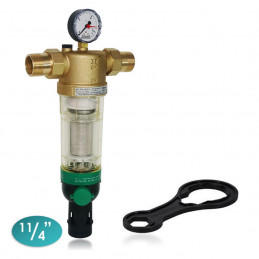
Honeywell F76S-11/4AA is a fine mesh filter with backwashing for water installations. It captures mechanical impurities, including rust particles and sand, ensuring a supply of filtered water even during the cleaning of the mesh. The transparent housing facilitates contamination monitoring, and the pressure gauge allows for monitoring operational parameters. Threaded connection 11/4".
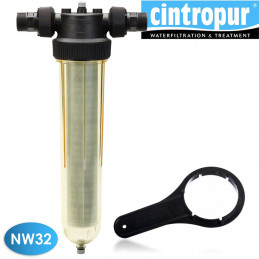
Cintropur NW32 is a modern pre-filter for water for the whole house, utilizing a cyclonic effect with a built-in centrifuge. It effectively reduces mechanical contaminants such as sand, silt, rust, and deposits. The package includes a polypropylene cartridge 25 microns , a service key, an air vent, and a drain plug for periodic flushing of the housing.
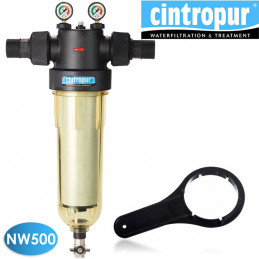
Cintropur NW500 is a modern pre-filter for water with a cyclone effect and a built-in centrifuge. It effectively reduces mechanical impurities such as sand, silt, rust, and suspensions. The set includes a polypropylene cartridge 25 microns , 2 glycerin manometers , a service key, and 2" GZ fittings. The transparent cover facilitates the monitoring of dirt.
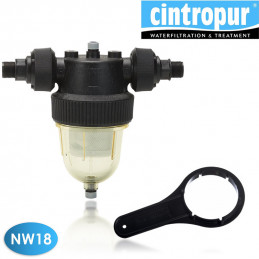
Cintropur NW18 is a complete mechanical filter for the main water supply, protecting the installation from sand, silt, rust, and other solid contaminants. It comes standard with a sock filter 25 microns , with the option to use filters of 5, 10, 50, or 100 microns. The transparent body facilitates contamination monitoring, and the vortex flow solution reduces pressure drops.
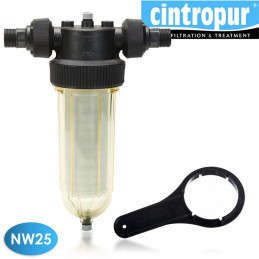
Cintropur NW25 is a modern pre-filter for water with a centrifuge and cyclone effect for separating impurities. It effectively reduces sand, silt, rust, and other suspensions. The set includes a service key and a factory polypropylene cartridge 25 microns . The filter has a drain plug for periodic flushing and a vent to facilitate servicing.
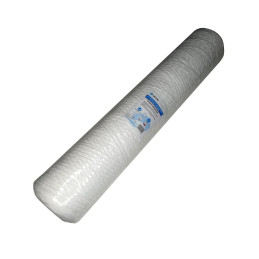
PPHOT20M20BB is a wound polypropylene cartridge for 20-inch Big Blue housings. It traps sand, rust and silt in water at 2–80°C. Flow rate up to 60 l/min.
Warm and hot water filtration is an element of a household water treatment system that is often overlooked, although it has a real impact on user comfort, installation durability, and the operation of heating devices. Water heated in the system may carry mineral deposits, rust, metal particles, chemical compounds, and organic contaminants that reduce its quality and may accelerate the wear of fittings and household appliances.
This category includes filters for hot water designed to operate at elevated temperatures. Their task is to support water treatment in homes and apartments, reduce deposits, rust, and other contaminants, and improve the comfort of everyday hot water use. A properly selected filter can help protect boilers, heating elements, fittings, and selected household appliances.
Why is hot and warm water filtration important?
Hot water filtration is important for the health and comfort of users. Heated water may contain various contaminants, such as mineral deposits, rust, bacteria, or chemicals, which may enter the heating system and internal installation.
Hot water filters help protect the installation and improve everyday comfort of use.
The most important benefits of using hot water filters are:
health protection – contaminants may negatively affect the body, especially during bathing, when warm water opens the pores; softer water may also help improve the condition of skin and hair,
extended device lifespan – filters help protect boilers, heating elements, and other heating system components from scale and corrosion,
greater comfort of use – better hot water quality is noticeable, among others, during bathing and laundry,
better household appliance performance – soft water does not promote graying and premature damage to fabrics, and detergents may work more effectively,
lower operating costs – less frequent failures and reduced deposit buildup may limit service and maintenance expenses.
What are hot water filters made of?
Filters intended for warm and hot water must be made of materials resistant to high temperature and corrosion. Their durability, safe operation, and effectiveness in a specific application depend on the raw materials used.
Hot water filtration uses materials resistant to temperature, corrosion, and contact with contaminants.
Most commonly used materials
stainless steel – commonly used in mechanical filters; it is durable, corrosion-resistant, and effectively retains larger particles such as sand or rust,
polycarbonate – used in filter housings because of its transparency, durability, and resistance to high temperatures; it allows easy inspection of the cartridge condition without dismantling the housing,
polypropylene – a popular material for mechanical filter cartridges; resistant to chemicals and high temperatures, it works well in removing fine particles from water.
Other materials used in hot water filtration
Depending on the type of filtration, other material solutions are also used:
activated carbon – often used in carbon filters, also in the form of carbon blocks with greater durability,
ceramic – found in some mechanical and chemical filters; valued for its effectiveness and resistance to high temperatures,
ion exchange resin – most often used in chemical filters to eliminate heavy metals,
quartz glass – used in UV filters because it transmits ultraviolet radiation and allows effective operation at high temperatures.
What contaminants can be found in hot water?
Hot water may contain mechanical, chemical, and organic contaminants. Each of these groups may affect safety of use, the condition of the installation, and the quality of water used for bathing, laundry, or other household applications.
Hot water may contain deposits, rust, bacteria, and chemical compounds that reduce its quality.
Mineral deposits
Calcium and magnesium are the main components of hard water. When heated, they form limescale deposits that build up on the internal surfaces of pipes, boilers, and heating devices. This may result in reduced thermal efficiency, higher energy costs, more frequent failures, and clogged shower nozzles and taps.
Rust and metal particles
Old water installations and heating components may corrode, releasing metal particles into the water. Rust is the result of metal oxidation during prolonged contact with water and oxygen. These types of contaminants may affect the taste, color, and comfort of water use, as well as increase the risk of installation damage.
Bacteria and microorganisms
Within a certain temperature range, especially around 20-50°C, some bacteria may develop, including Legionella. This is particularly important in the case of domestic hot water. Regular cleaning and disinfection of water systems are an important part of prevention, and properly selected filtration solutions support maintaining better water quality.
Chemicals and heavy metals
Water may contain chlorine and its derivatives, as well as, in some regions, heavy metals such as lead, mercury, and cadmium. Chlorine may react with other substances present in water, forming compounds such as THM and HAN. Carbon filters are effective in reducing chlorine and its derivatives, improving water quality and its usability.
Organic deposits
Warm water may also contain algae, fungi, protozoa, as well as silt and sludge. Organic contaminants may form biofilms, clog pipes, reduce flow, and negatively affect the efficiency of heating systems.
How to choose a hot water filter?
Choosing the right solution is best based on the type of problem and the operating conditions of the installation. In practice, the following criteria are helpful:
operating temperature – the filter and housing must be adapted for use with warm or hot water,
type of contaminants – one solution will work for rust and sand, while another will be suitable for chlorine, heavy metals, or water hardness problems,
material of construction – in installations with elevated temperatures, resistance to corrosion and operational loads is especially important,
installation location – the filter may protect an entire selected section of the installation, a heating device, or a point of use,
ease of inspection and service – transparent housings and easily accessible cartridges make everyday operation easier.
In the case of warm and hot water, random filters intended only for cold water should not be used. The key issue is the product's compatibility with the operating temperature range and the nature of contaminants present in the installation.
Summary of the most important information
Area
Most important information
Application
Filters for warm and hot water support water treatment in homes and apartments and help protect the installation and devices.
Main benefits
Health protection, improved comfort, better skin and hair condition, extended device lifespan, reduction of deposits and corrosion.
Typical contaminants
Mineral deposits, rust, metal particles, bacteria, chemicals, heavy metals, biofilms, silt, and sludge.
Reducing limescale and corrosion may improve the operating efficiency of boilers, heating elements, and other heating system components.
Filters for warm water treatment in the store's offer
The store's offer includes high-quality products that help deal with mechanical, chemical, and organic contaminants present in hot water. These are solutions for houses and apartments for people who want to improve water quality and better protect the installation from the effects of deposits, corrosion, and other operational problems.
FAQ – frequently asked questions
Why is it worth using warm water filters?
Hot water filtration helps remove contaminants such as mineral deposits, rust, bacteria, and chemicals. As a result, it may improve comfort of water use, support the protection of skin and hair, and reduce scale buildup in devices and the installation.
How do hot water filters affect laundry quality?
Better water quality and lower hardness may reduce graying and premature damage to fabrics. In practice, this means more comfortable laundry and better use of detergents.
What materials are warm water filters made of?
The most commonly used materials are stainless steel, polycarbonate, and polypropylene. Depending on the type of filtration, activated carbon, ceramic, ion exchange resin, and quartz glass in UV solutions are also used.
What contaminants are most commonly found in hot water?
Typical problems include mineral deposits, limescale, rust, metal particles, bacteria, chlorine and its derivatives, heavy metals, and organic contaminants such as biofilms, silt, or sludge.
Does a hot water filter help protect the boiler and heating elements?
Yes, a properly selected filter may reduce deposit buildup and lower the risk of corrosion, which supports longer and more efficient operation of boilers, heating elements, and other components of the heating system.
Can every filter be installed for warm water?
No. In warm and hot water installations, only products adapted for operation at elevated temperatures should be used. It is always worth checking the filter's intended use and compatibility with the installation's operating conditions.
Do hot water filters improve bathing comfort?
Yes, reducing some contaminants and improving water quality may translate into greater comfort of everyday use. Many people also point to the beneficial effect of softer water on skin and hair.
How to choose the right hot water filter for a house or apartment?
It is best to consider operating temperature, type of contaminants, material of construction, installation location, and ease of service. In cases of hardness, rust, chlorine, or heavy metals, it is worth matching the type of filtration to the specific application.
Does hot water filtration matter for the household budget?
Yes, because reducing scale and corrosion may decrease the frequency of failures and the need for device maintenance. Indirectly, this translates into lower operating costs of the installation and household equipment.