Results could not be refreshed. Your previous selection was restored.
Price
Filtering products…
Brand
Salt-free water treatment stations | Softeners and Iron Removal Systems
Water treatment is increasingly based on modern and more eco-friendly solutions. Salt-free water treatment stations help reduce the problem of hard water and limescale buildup, and with the right configuration they can also support the removal of excess iron.
Unlike traditional softeners, such devices do not require the use of tablet salt. This is a convenient solution for people looking for simpler operation, less interference with the installation, and environmentally friendly technology.
In this category, you will find salt-free water softeners and iron removal systems for home use and selected utility applications. Check how they work, what advantages they offer, and when it is worth choosing a water treatment station without salt and chemicals.
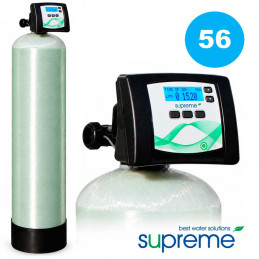
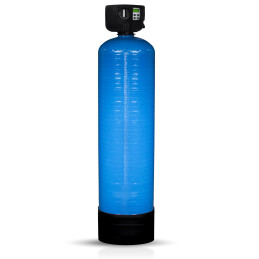
OXYLINE PLUS 56 Supreme is a modern, eco-friendly station for removing iron and manganese and reducing hydrogen sulfide. During regeneration, the device draws in air and creates an air cushion in the tank, allowing it to operate without additional aeration and without the use of chemicals for regeneration. Automatic time control, CLACK valve, and Katalox Light media ensure convenient and effective operation even at low pH (from 6.0).
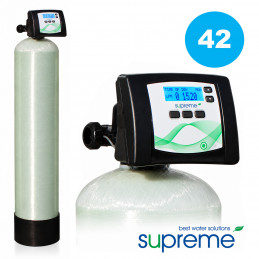
OXYLINE PLUS 42 Supreme is a modern, eco-friendly iron and manganese remover with hydrogen sulfide reduction. During regeneration, the device draws in air and creates an air cushion in the tank, which aerates the water without the need for an additional aerator. It operates automatically thanks to the electronic controller and CLACK valve, without the need for chemicals for regeneration. It works with diaphragm and flow pumps.
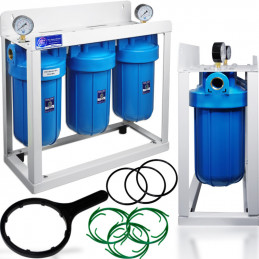
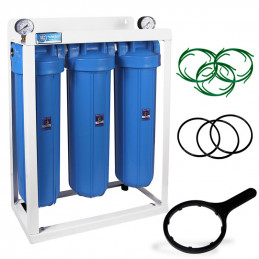
HHBB10B Aquafilter is a three-stage water treatment station in a steel frame, based on 3 BIG BLUE 10" housings. It serves as a foundation for building a home filtration system, with the option to select cartridges based on water issues (turbidity, chlorine, scale, iron). The set includes 2 pressure gauges that facilitate the assessment of pressure drop and the timing for cartridge replacement. Filter cartridges are not included.
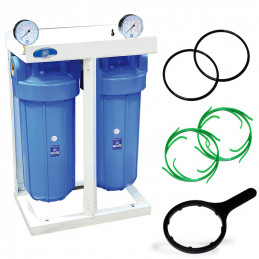
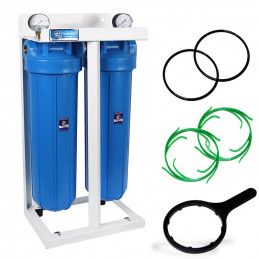
Aquafilter HHBB10A is a double water filtration station in a steel frame, based on the BIG BLUE 10" standard. It allows for the selection of cartridges for issues such as sand, silt, rust, chlorine, excess iron, or hard water. The set includes 2 pressure gauges that facilitate the assessment of cartridge usage and 2 antibacterial centering discs BACinix . Freestanding design, no need for installation towalls.
HHBB20B Aquafilter is a three-stage water treatment station on a steel frame, based on 3 Big Blue 20" housings. It allows for the selection of cartridges according to water quality (e.g., mechanical, carbon, softening, de-ironing). The set includes 2 pressure gauges that facilitate monitoring of pressure drop and 3 antibacterial centering disks BACinix with nanosilver. Floor installation without wall mounting.
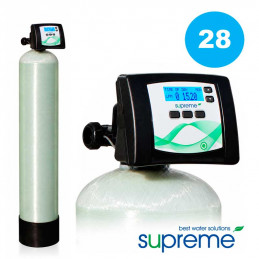
OXYLINE PLUS 28 Supreme is a modern, eco-friendly station for removing iron, manganese, and hydrogen sulfide from water. During regeneration, the device draws in air and creates an air cushion in the tank, ensuring effective aeration without additional aerators. It operates automatically thanks to electronic time control and a CLACK valve. It works with diaphragm and flow pumps.
HHBB20A Aquafilter is a water treatment station on a steel frame, based on 2 housings in the BIG BLUE 20" standard. It is a solid foundation for building a home filtration system with cartridges selected according to water quality (e.g., mechanical, softening, de-ironing, carbon). The set includes 2 pressure gauges that facilitate monitoring of pressure drop and 2 centering discs BACinix withnanosrebrem.
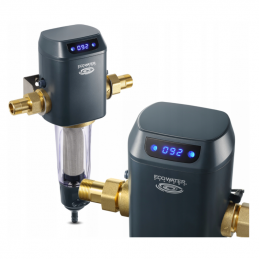
EcoWater SMART is an automatic pre-filter for cold water, installed on the main supply line. It removes mechanical impurities and suspensions, trapping them on a stainless steel mesh (100 microns). The cartridge is automatically flushed (cycle 1-99 days), and the impurities are directed to the sewage system. The filter also features manual flushing, a brass head, a check valve, and a pressure reducer.
The SORB 75 carbon column is an advanced device used in water treatment processes, distinguished by numerous advantages due to its unique design and properties.
Salt-free treatment stations are modern solutions for users who want to reduce the effects of hard water, improve the comfort of using their installation, and minimize sediment problems without the need for tablet salt. Depending on the technology and water quality, they may support not only scale protection but also the reduction of iron, manganese, and some mechanical impurities.
What will you find in this category? Salt-free and chemical-free water treatment stations that help reduce limescale buildup, protect the installation and household appliances, and in suitable configurations also support the removal of excess iron and manganese. These solutions use, among others, catalytic and electromagnetic technologies as well as media supporting mechanical filtration. Their important advantage is that there is no need to refill salt and no brine discharge into wastewater.
Modern salt-free water treatment systems help reduce the effects of hard water without using tablet salt.
What is a salt-free and chemical-free treatment station?
A salt-free water treatment station is an innovative device that, unlike traditional softeners, does not require adding salt tablets. Thanks to specialist media or physical technologies such as catalytic solutions or an electromagnetic impulse, such an installation makes it possible to reduce limescale buildup and, with the right configuration, also remove excess iron.
This solution is valued by users who want to improve water quality in a more environmentally friendly way. A major advantage is that salt-free devices do not generate salty wastewater, and their operation can be simpler and less burdensome on a daily basis.
Why choose a salt-free treatment device instead of a traditional one?
Choosing a treatment device without salt and chemicals means convenience, reduced maintenance, and a modern approach to protecting your home water installation.
Eco-friendliness and savings – no need to refill salt means lower expenses and less troublesome operation.
Less waste – salt-free devices do not produce brine discharge, which has a positive effect on the environment and the sewage network.
Minimal interference with the installation – salt-free treatment devices usually do not require additional salt tanks or complicated connections.
Multifunctionality – salt-free solutions can simultaneously reduce the risk of limescale formation and also remove iron or manganese depending on the media used.
User convenience – no need to store heavy salt bags and fewer maintenance tasks.
How do salt-free treatment stations work?
The basic task of salt-free stations is to improve water quality by changing the structure of the ions responsible for hardness, mainly calcium and magnesium, and—in some configurations—removing excess iron. Instead of classic ion exchange, physical or catalytic phenomena are used here to reduce the ability of scale to deposit and to help transform compounds dissolved in water into forms that are less troublesome for the installation.
In practice, this means that the aim of such devices is not always the complete removal of minerals from water, but above all reducing the effects of hardness and improving the operating conditions of the installation, fittings, and heating equipment.
Technologies used in salt-free stations
Catalytic technology
In the catalytic process, the particles responsible for water hardness, namely calcium and magnesium, crystallize into a form that does not easily adhere to the surfaces of pipes, fittings, or household appliances. Special catalytic media initiate a change in their structure, making the water less prone to sediment formation and preventing flow from being easily restricted by accumulated scale.
Among this group, you can find, among others:
crystallizing media – modify water hardness without removing minerals, so the water retains its natural properties,
multifunctional media – in addition to catalysis, they can partially capture certain metals and other impurities.
Electromagnetic treatment
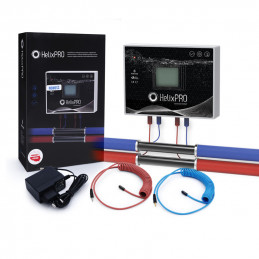
In salt-free electromagnetic systems, water flows through a chamber where it is affected by a specially generated magnetic field. This modifies the form of the ions responsible for hardness, making scale more difficult to precipitate and deposit on fittings.
The main advantages of this technology are:
easy installation in the system, often using a small device fitted around the pipe,
no need for regular cartridge replacement or media refilling,
physical operation that does not change the chemical composition of the water.
Polyphosphate media
In some installations, water may be treated with small amounts of polyphosphates, which bind hardness ions and reduce the effects of limescale buildup. It is worth emphasizing, however, that some experts consider only solutions based on physical or catalytic methods to be fully salt-free. Polyphosphates can be a useful addition, but they require regular refilling and usually do not constitute a standalone solution in more advanced salt-free systems.
Mechanical filter media
Additional mechanical media, such as Turbidex or filter sand, help remove solid contaminants from water, for example particles of rust, sand, and silt. In salt-free stations, they support the operation of the main technologies, improve water clarity, and are especially useful when turbidity is elevated.
The choice of salt-free technology should be based on water parameters and the expected practical effect.
The most important advantages and limitations of salt-free treatment
Advantages
no need to buy and store salt and chemicals,
no brine wastewater, which is beneficial for the environment,
easier and often cheaper operation in the long term,
the possibility of retaining valuable minerals in the water,
reduced limescale buildup in the shower, on fittings, and in household appliances,
protection of the water installation and heating elements against the negative effects of hard water.
Disadvantages and limitations
with very high water hardness, effectiveness may be more limited than with classic ion-exchange softeners,
some technologies require very careful matching to the chemical composition of the water and its pH,
in some cases, additional filters are necessary for more effective removal of iron, manganese, or mechanical impurities.
The best results are achieved by selecting the device based on a water test. This is especially important when, in addition to hardness, iron, manganese, turbidity, or variable well water composition are also present.
Is a salt-free softener effective?
A chemical-free and salt-free water softener can effectively minimize the problem of limescale, although in some situations the effect will not be as intense as in devices based on ion exchange. If the goal is to protect household appliances, the installation, and reduce deposits, salt-free water treatment stations work very well.
Users often notice improvement in the form of less sediment in kettles, on shower enclosures, or on fittings. The benefits are also visible in laundries and gastronomy, where heating elements and nozzles do not clog as easily as they do with hard water.
Salt-free iron removal – an effective alternative
When water contains excessive amounts of iron, it can cause an unpleasant taste, staining of sanitary fixtures, and discoloration on laundry. A salt-free iron removal system can remove or reduce iron without the need for regeneration salt, providing a convenient and more eco-friendly alternative to classic methods.
A salt-free iron removal system can use catalytic media that accelerate iron oxidation and its precipitation from water. The solid particles are then retained on the filter media or removed during periodic backwashing. This process is often supported by pre-aeration, which further promotes iron oxidation.
Benefits of iron removal without using salt
eco-friendly approach – no brine in wastewater,
lower operating costs – no need to purchase regeneration salt,
simpler operation – fewer maintenance tasks than in some traditional solutions,
versatility – the possibility of combining with technologies that reduce hardness, manganese, or other compounds.
Applications of salt-free treatment devices in households
Salt-free devices work well in homes where owners want to reduce problems related to hard water or excess iron while not burdening the environment and simplifying installation maintenance.
Most commonly indicated benefits in a single-family home
reduced limescale buildup in the shower, in household appliances, and in the heating installation,
protection of the water installation against narrowing pipe cross-sections and sediment,
improved practical qualities of water – fewer spots and streaks on fittings,
no need for cyclical purchases of heavy salt bags,
the possibility of reducing costly repairs related to iron deposits or limescale,
lower energy consumption in heating equipment if the heating elements are not covered with a layer of sediment.
How to choose the right salt-free treatment station?
It is worth basing the selection of a device not only on the slogan “salt-free,” but above all on the actual water parameters and the expected effect. A home with moderately hard municipal water needs a different solution than a building with its own well where iron, manganese, or turbidity are present.
check water hardness and the presence of iron and manganese,
determine whether the main problem is limescale, water discoloration, sediment, or turbidity,
pay attention to whether the device is to operate independently or as part of a larger filtration system,
assess the available installation space and the required level of interference with the system,
compare later operating costs and the scope of necessary maintenance.
Key information at a glance
Area
What is worth knowing
Operating method
Most often uses physical or catalytic technologies instead of classic ion exchange.
Tablet salt
There is no need to regularly refill regeneration salt.
Installation
Usually no additional salt tanks or complicated connections are required.
Practical effect
The devices help reduce limescale buildup and, in selected configurations, also reduce iron and manganese.
Operation
Maintenance can be simpler and less burdensome than in traditional salt-based systems.
Selection
The best results are achieved after matching the technology to the water test results.
FAQ – frequently asked questions
What is a salt-free water treatment station?
It is a device that helps reduce the effects of hard water and, depending on the configuration, can also reduce iron or manganese without the need to use tablet salt. Instead of classic ion exchange, it most often uses physical, catalytic, or filtration-supporting technologies.
Does a salt-free treatment device really soften water?
In many cases, such devices do not remove minerals in the same way as ion-exchange softeners, but they effectively reduce limescale buildup and improve installation operating conditions. Therefore, the practical effect can be very beneficial, even if the operating mechanism is different from that of salt-based devices.
Does a salt-free station remove iron from water?
Yes, but only when it has been equipped with the appropriate iron removal technology or media. Not every salt-free station works identically, so in the case of an iron problem it is worth checking the water parameters and matching the solution to the specific composition.
What are the biggest advantages of salt-free devices?
The most frequently mentioned are no need to refill salt, no brine wastewater, simpler operation, less interference with the installation, and a more eco-friendly nature of use. For many users, convenience and no need to store heavy salt bags are also important.
Will a salt-free treatment device work with very hard water?
It can be effective, but with very high hardness its effect may be more limited than with classic ion-exchange softeners. In such cases, comparing technologies and matching the device to the actual water parameters is crucial.
Do salt-free devices change the chemical composition of water?
It depends on the technology. Electromagnetic solutions work physically and do not change the chemical composition of the water, while systems based on media may affect the behavior of compounds present in the water or remove selected impurities.
When is it worth performing a water test before purchase?
A water test is worth performing whenever you use your own water source, notice sediment, discoloration, a metallic taste, or problems with fittings and household appliances. The analysis helps select a technology that is effective not only against hardness, but also iron, manganese, or turbidity.
Do salt-free treatment stations require maintenance?
Yes, although the scope of maintenance is usually smaller than in traditional salt-based systems. Depending on the model, it may be necessary to monitor device operation, perform periodic backwashing, replace cartridges, or service the filter media.
Is a salt-free iron removal system suitable for a single-family home?
Yes, such solutions are often chosen for single-family homes, especially when the user wants to reduce iron and improve the comfort of water use without using regeneration salt. However, the condition is proper selection of the device to match the water parameters.