Results could not be refreshed. Your previous selection was restored.
Price
Filtering products…
Brand
Under-sink water filters without reverse osmosis
Under-sink water filters without reverse osmosis are compact kitchen filtration systems designed to improve the taste, odour and quality of tap water without using an RO membrane. This category includes flow-through filters installed under the sink that reduce chlorine, sediment and selected contaminants while retaining naturally occurring minerals in the water. They provide convenient water for drinking and cooking and help reduce the need to buy bottled water.
Aquafilter FP3-HJ-K1 is a 4-stage under-sink system with a TLCHF-2T capillary membrane and a separate faucet FXFCH5. The filtration includes a mechanical cartridge FCPS5 (up to 5 µm), a softening and de-ironing cartridge FCCST2, and a carbon cartridge with KDF FCCBKDF. The set improves the taste and smell of water, reduces chlorine, sediments, heavy metals, and helps limit the growth of microorganisms.
Technology
Ultrafiltration
Stages
4 etap
Filtration function
Chlorine, taste and odor reduction, Iron removal, Sediment removal, Ultrafiltration
3-stage water filter under the sink AQUAFILTER for pre-filtration and softening. Stage I: FCPS20 cartridge made of 20-micron polypropylene fiber removes sludge and sediments. Stages II and III: FCCST cartridges with ion exchange resin reduce hardness (calcium and magnesium ions). The set includes housings on a frame, 2 connections 1/2", 2 pressure gauges, BACinix antibacterial discs with nanosilver, a wrench, and Teflon tape.
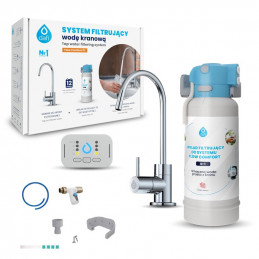
454.99Dafi Flow Comfort is an advanced filtration system that provides quick access to tasty, filtered water straight from the tap, with smart LED indicators, protection against limescale buildup, and a quality guarantee, creating a healthy and sustainable alternative to bottled water.
Three-stage pre-filter for under-sink installation based on original Aquafilter parts. The set combines mechanical filtration (FCPS20 20 micron cartridge), softening on an ion exchange resin (FCCST), and chlorine reduction, as well as improvement of taste and odor thanks to the coconut shell carbon cartridge (FCCBL-S). The 3-part housings feature a transparent 10" cover, with a 1/2" internal thread. Included are 2 pressure gauges, a wrench, and Teflon tape.
Technology
Activated-carbon filtration, Ion exchange, Mechanical filtration
Stages
3 etap
Connection
1/2″
Filtration function
Chlorine, taste and odor reduction, Sediment removal, Softening
FP3-2 Aquafilter is an under-sink water filtration system , designed to purify water and improve its taste and odor. The set includes two mechanical cartridges (FCPS5 and FCPS20) for removing sand, rust, and sediments, as well as a carbon cartridge (FCCBL) that reduces chlorine, pesticides, and organic substances. The package also includes a faucet, connections, and mounting accessories.
DAFI Flow Comfort D1 is a compact flow filter installed under the sink that provides constant access to tasty tap water. The ion exchange resin and activated carbon reduce hardness, chlorine, and selected metals (including copper and lead), improving taste and smell. The system is easy to install, features a 4-stage softening adjustment, flood protection, and an LED indicator for cartridge replacement. The set includes the ALTO tap for filtered water.
Technology
Activated-carbon filtration, Ion exchange
Stages
4 etap
Flow
4.3 l/min
Filtration function
Chlorine, taste and odor reduction, Sediment removal, Softening
Three-stage pre-filter for under-sink cold water, based on original Aquafilter parts. The set includes a 1/2" connection and starter cartridges: FCPS20 (20 microns) + carbon cartridges made from coconut shells, including KDF. It helps remove mechanical impurities, reduce chlorine, and improve the taste and smell of water. The package includes, among other things, 2 pressure gauges, a wrench, Teflon tape, and BACinix discs.
Technology
Activated-carbon filtration, Mechanical filtration, Media filtration
Stages
3 etap
Connection
1/2″
Filtration function
Antibacterial action, Chlorine, taste and odor reduction, Iron removal, Sediment removal
Aquafilter FP3-K1N is a 3-stage water filter mounted under the sink, with a set of cartridges for about 6 months. It combines 5-micron mechanical filtration (FCPS5), softening, and reduction of iron and hydrogen sulfide (FCCST2), along with a carbon filter with KDF (FCCBKDF) that improves the taste and smell of water. The set also includes a chrome faucet and installation accessories.
Technology
Activated-carbon filtration, Ion exchange, Mechanical filtration, Media filtration
Aquafilter FP3-K1N is a 3-stage under-sink water filter with a carbon cartridge containing KDF. The set includes: a mechanical filter FCPS5 (up to 5 µm), a conditioning cartridge FCCST2 (softening and iron reduction), and a cartridge FCCBKDF (chlorine reduction, organic compounds and heavy metals, improving taste and odor). The complete set also includes a separate faucet with a ceramic head and mounting accessories.
Technology
Activated-carbon filtration, Ion exchange, Mechanical filtration, Media filtration
Stages
3 etap
Filtration function
Chlorine, taste and odor reduction, Iron removal, Softening
Dafi Flow Comfort is an advanced filtration system that provides quick access to tasty, filtered tap water, featuring smart LED indicators, protection against limescale buildup, and a quality guarantee, creating a healthy and sustainable alternative to bottled water.
Dafi Flow Comfort is an advanced filtration system that provides quick access to tasty, filtered tap water, featuring smart LED indicators, protection against limescale buildup, and a quality guarantee, creating a healthy and sustainable alternative to bottled water.
5-stage under-sink filtration system with UF membrane is an innovative solution for those who want to enjoy clean, healthy, and tasty water in their home
Technology
Ultrafiltration
Stages
5 etap
Connection
1/2″
Filtration function
Antibacterial action, Chlorine, taste and odor reduction, Iron removal, Sediment removal, Softening, Ultrafiltration
The Dafi Flow Comfort D1 under-sink set with a black ALTO faucet provides quick access to delicious water straight from the tap. The ion exchange resin and activated carbon reduce hardness, improve taste and odor, and limit chlorine. The package includes 2 D1 cartridges (replacement), an electronic LED indicator, and a hardness test strip. Non-invasive installation and protection of appliances against limescale.
Three-stage pre-filter for under-sink installation with a 1/2" connection. The set combines mechanical filtration (FCPS20 20-micron cartridge), iron removal (FCCFE cartridge), and chlorine reduction and water taste improvement (FCCBL-S carbon cartridge). The package includes, among other things, 3 three-part housings on a frame, 2 pressure gauges, 3 antibacterial centering discs, a wrench, and Teflon tape, as well as starter cartridges.
Technology
Activated-carbon filtration, Mechanical filtration, Media filtration
Stages
3 etap
Connection
1/2″
Filtration function
Chlorine, taste and odor reduction, Iron removal, Manganese removal, Sediment removal, Softening
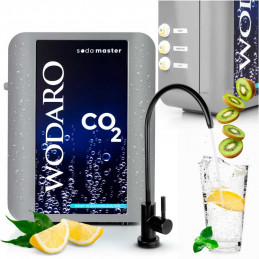
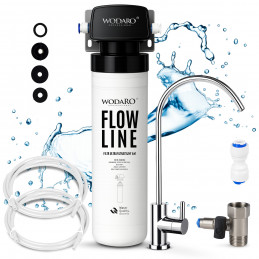
WODARO FLOWLINE is a compact under-sink flow filter with a 4-in-1 cartridge and UF ultrafiltration at 0.01 µm. It combines calcium sulfite, activated carbon, KDF media, and a UF membrane to reduce chlorine, unpleasant odors, heavy metals, pesticides, mechanical impurities, and microorganisms. The Fast-Change system allows for cartridge replacement in seconds, without tools and without spilling water.
Technology
Activated-carbon filtration, Media filtration, Ultrafiltration
Stages
2 etap
Connection
1/2″, 1/4″
Filtration function
Antibacterial action, Chlorine, taste and odor reduction, Sediment removal, Ultrafiltration
DAFI Flow Comfort DC10 is an under-sink filtration system with a black tap , which provides constant access to fresh, tasty water directly from the filtered water faucet. It reduces chlorine, improves taste and odor, and helps limit limescale buildup in appliances. The set includes 2 DC10 cartridges (a longer-lasting supply), an LED replacement indicator, and mounting components.
Under-sink water filters without reverse osmosis are compact kitchen systems designed to improve the taste, odour and quality of water without using a reverse osmosis membrane. They are installed inside the cabinet beneath the sink, so they do not take up space on the worktop and provide constant access to filtered water for drinking, cooking and preparing coffee or tea.
This category contains only under-sink filters without reverse osmosis. These include flow-through filters, compact cartridge systems, multi-stage sets and selected models with a capillary or ultrafiltration membrane. They do not require a storage tank for RO water and generally do not produce wastewater.
What can you find in this category? This category includes under-sink filters designed primarily to reduce chlorine, sediment, rust, sand and substances that adversely affect the taste and odour of water. The exact filtration range depends on the type of cartridges used and the design of the specific system.
An under-sink filter without reverse osmosis provides convenient access to filtered water without taking up space on the kitchen worktop.
How does an under-sink water filter without reverse osmosis work?
An under-sink filter without reverse osmosis purifies water as it flows through appropriately selected filter cartridges. Depending on the model, the system may consist of one compact cartridge or several filtration stages installed in separate housings.
The following components are most commonly used in this type of filter:
mechanical cartridges – capture sand, rust, silt and other solid particles,
carbon cartridges – help reduce chlorine and improve the taste and odour of water,
specialist cartridges – may reduce selected heavy metals, organic compounds or other contaminants specified by the manufacturer,
softening cartridges – locally reduce water hardness and help limit deposits in kettles or coffee machines,
capillary and ultrafiltration membranes – provide more precise filtration of fine contaminants in suitably equipped systems.
Filters without reverse osmosis do not purify water in the same way as RO systems. However, they also do not remove most naturally occurring minerals from the water and provide a fast flow rate without the need to store water in a tank.
Main benefits of under-sink filters without reverse osmosis
Improved taste and odour of water – a properly selected carbon cartridge helps reduce chlorine and substances that adversely affect the organoleptic properties of water.
No wastewater – a standard flow-through filter uses water without discharging part of the stream into the drain.
Retention of minerals – filtration without an RO membrane does not cause such extensive demineralisation of water.
High flow rate – filtered water is available on demand without waiting for a storage tank to refill.
Compact installation – the system is located inside the cabinet beneath the sink and does not take up valuable worktop space.
Simpler maintenance – cartridge replacement is generally straightforward, and the system does not require maintenance of an RO membrane.
Adjustable filtration – in multi-stage systems, cartridges can be selected to address specific water problems.
Reduced use of bottled water – access to filtered water in the kitchen helps reduce the need to buy, carry and store water bottles.
An under-sink system combines convenient water filtration with space-saving installation in the kitchen.
Types of under-sink filters without reverse osmosis
Compact under-sink flow-through filter
A compact under-sink flow-through filter takes up little space and uses one replaceable cartridge or a closed filtration module. It is a good solution when the main objective is to improve the taste and odour of tap water and reduce chlorine.
This type of filter can be connected to a separate filtered-water tap, a three-way kitchen tap or, in selected models, directly to the existing kitchen tap.
Multi-stage under-sink water filter
Multi-stage under-sink filters without reverse osmosis usually consist of two, three or four housings. Each stage can perform a different function, such as mechanical filtration, chlorine reduction, taste improvement or the reduction of selected contaminants.
An example configuration may include:
a mechanical cartridge that captures sediment and solid particles,
a granular activated carbon cartridge,
a carbon block cartridge for more precise filtration,
a specialist cartridge selected for a specific water problem.
The advantage of a multi-stage system is the ability to replace individual cartridges and adapt the configuration to the quality of the water and the needs of the users.
Under-sink filter with ultrafiltration
Some filters without reverse osmosis use a capillary or ultrafiltration membrane. Such a system provides more precise filtration than a standard mechanical and carbon set, while not operating like an RO membrane and not producing the wastewater discharge typical of reverse osmosis.
The filtration precision and range of the membrane depend on the specific model, so the technical parameters and manufacturer’s declarations should be checked before purchase.
The filtration method can be matched to the water quality, available space and expected result.
Which under-sink filter without reverse osmosis should you choose?
The selection of a filter should begin by identifying the specific water problem that needs to be addressed. This helps avoid purchasing a system that is either too basic or equipped with unnecessary filtration stages.
Filter for improving the taste and odour of water
If the tap water is safe but has a noticeable chlorine taste or odour, an activated carbon flow-through filter is usually a suitable choice. This may be a compact single-cartridge filter or a two- or three-stage system.
Filter for water containing sediment and rust
If there are visible particles, sand, rust or deposits from the plumbing system, it is worth choosing a filter with a mechanical stage. A sediment cartridge protects the subsequent cartridges and improves water clarity.
Filter for reducing limescale in a kettle
A system with a softening cartridge or a specialist anti-scale cartridge can be used to locally reduce water hardness. However, an under-sink filter only treats the water used in the kitchen and does not replace a central water softener serving the entire house.
Filter for more precise purification without RO
If you expect more precise filtration but do not want a reverse osmosis system, consider models equipped with a capillary or ultrafiltration membrane. Before purchase, check the filtration precision, required inlet water quality and range of contaminants reduced.
Important: The effectiveness of a filter depends on the cartridges used, the quality of the inlet water, the flow rate and timely replacement of filtration components. A carbon cartridge alone should not be treated as microbiological protection for the water.
What should you consider before purchase?
Type of water problem – determine whether the issue concerns chlorine, taste, odour, sediment, hardness or the need for more precise filtration.
Number of filtration stages – a larger number of housings allows several types of cartridges to be used but requires more space.
Filter capacity – check the maximum water flow rate and match it to the intended use.
System dimensions – measure the available space in the cabinet beneath the sink, including the clearance required to replace the cartridges.
Water dispensing method – check whether the set requires a separate tap, a three-way tap or can work with the existing kitchen tap.
Type and availability of cartridges – check the prices, expected service life and availability of replacement components.
Operating pressure – make sure the installation parameters comply with the device requirements.
Quality of the inlet water – for well water, the system should be selected on the basis of a current water analysis.
Comparison of under-sink filters without reverse osmosis
Filter type
Main application
Key features
Who is it for?
Compact flow-through filter
Improving the taste and odour of water
Compact dimensions, simple installation, one filtration module
For users who need basic filtration of tap water
Multi-stage filter
Reduction of several types of contaminants
Several replaceable cartridges and an adjustable configuration
For users who need more advanced filtration
Filter with ultrafiltration
More precise filtration without an RO membrane
Capillary or ultrafiltration membrane, no typical wastewater discharge
For users who expect a higher level of filtration without reverse osmosis
Filter with a softening cartridge
Local reduction of water hardness
Helps reduce deposits in kettles and coffee machines
For households with moderately hard water used in the kitchen
An under-sink system can be selected according to the available space, water quality and expected filtration range.
Why is it worth installing a filter under the sink?
An under-sink filter without reverse osmosis provides convenient access to filtered water exactly where it is most often used. The water can be drawn directly for drinking, cooking, preparing beverages and filling a kettle or coffee machine.
The system remains hidden inside the cabinet, does not require constant refilling like a filter jug and helps reduce the need to store bottled water. Thanks to replaceable cartridges, the filtration method can also be adapted more easily to changing needs.
An under-sink filter provides constant access to water for drinking and cooking without taking up space on the worktop.
FAQ – under-sink water filters without reverse osmosis
How does an under-sink filter without reverse osmosis differ from an RO filter?
A filter without reverse osmosis uses mechanical, carbon or specialist cartridges, or ultrafiltration membranes, but does not contain a reverse osmosis membrane. It generally does not produce wastewater, provides a higher flow rate and does not remove minerals from the water to the same extent as an RO system.
Does an under-sink filter without reverse osmosis improve the taste of water?
Yes, provided that a suitable cartridge, usually a carbon cartridge, is used. Activated carbon helps reduce chlorine and substances that adversely affect the taste and odour of water.
Does a filter without reverse osmosis retain minerals in the water?
Standard mechanical and carbon filters do not cause such extensive demineralisation as reverse osmosis. However, the exact effect on the composition of the water depends on the specialist cartridges used.
Does an under-sink filter without reverse osmosis produce wastewater?
Standard flow-through filters without an RO membrane do not discharge part of the water into the drain. The entire stream passes through the cartridges and flows to the tap.
Does an under-sink filter remove chlorine?
A filter equipped with a suitable activated carbon cartridge can effectively reduce chlorine and improve the taste and odour of water. The precise range of operation should be checked in the specification of the particular cartridge.
Does a filter without reverse osmosis reduce limescale?
Only models equipped with a softening cartridge, anti-scale cartridge or another component designed to reduce water hardness. A standard mechanical or carbon cartridge does not remove the compounds responsible for limescale formation.
Does an under-sink filter without reverse osmosis remove bacteria?
A standard mechanical and carbon filter should not be treated as protection against bacteria. This function may be provided by selected systems with a suitable capillary or ultrafiltration membrane, in accordance with the manufacturer’s declaration and provided that the correct operating conditions are maintained.
Is a separate filtered-water tap required?
This depends on the design of the set. Some filters work with a separate tap, others can be connected to a three-way tap, while selected models filter all cold water supplied to a standard kitchen tap.
How often should the cartridges in an under-sink filter be replaced?
The replacement frequency depends on the type of cartridge, the quality of the water, water consumption and the manufacturer’s recommendations. A cartridge should be replaced no later than after reaching the stated operating time or capacity expressed in litres.
Is an under-sink filter without reverse osmosis suitable for well water?
It may be used as a final filtration stage, but its selection should be based on current water test results. A kitchen filter does not replace central water treatment in the event of high levels of iron, manganese, ammonium, bacteria or other serious exceedances.
Which under-sink filter without reverse osmosis should I choose?
An activated carbon filter is usually sufficient to improve taste and odour. A mechanical cartridge is also required for sediment, while a multi-stage system or an ultrafiltration model is worth considering for more demanding filtration.