
- There are no more items in your cart
- Shipping
- Total 0.00 zł





Density of water: what it depends on, the influence of temperature, and anomalies

Water is an extraordinary substance that breaks many physical rules, and its density is the best example of this. Although we intuitively assume that 1 liter of water is exactly 1 kilogram, in reality, this value fluctuates depending on temperature, pressure, and the level of contamination. Understanding what water density is and how it changes is crucial not only in laboratories but also in home heating systems, aquaristics, or processeswater treatment.
Table of Contents
- What is the density of water and how do we define it?
- Anomaly of water density and the effect of temperature
- Numerical values: density at 20°C, 4°C, and boiling point
- The effect of minerals and salinity on density
- Practice: How to measure and use this knowledge?
- Common mistakes in understanding density
In this article, you will learn:
- Why ice floats on the surface instead of sinking.
- What is the density of water at room temperature and at boiling point.
- Howtemperature affects the volume of liquid in your heating system.
- What is the difference between "dense water" and hard water.
- What are the relationships between the density of water and its purity.
What is the density of water and how do we define it?
Brief answer: Density is the ratio of the mass of a substance to its volume. In the case of water, this parameter changes non-linearly with temperature,reaching its maximum at around 4°C. This is crucial for biological life in aquatic environments and for designing hydraulic systems.
In physics, density is denoted by the Greek symbol ro ($\rho$) and is expressed by the formula:
$$\rho = \frac{m}{V}$$
Where $m$ is mass and $V$ is volume. The basic unit in the SI system is $kg/m^3$, although in everyday life we more often use $g/cm^3$ or $kg/dm^3$. IdeallyPure water at the maximum density temperature (3.98°C) has a density close to 1000 kg/m³ (or 1 g/cm³). However, in practice, we rarely encounter ideal conditions.
Key point: Water is not "volume-stable." Heating 1000 liters of water in a system from 4°C to 90°C will increase its volume by several dozen liters, which necessitates the use of diaphragm vessels.
The anomaly of water density and its impacttemperatures
Most substances contract (increase in density) when cooled and solidified. Water behaves differently. This phenomenon is called the density anomaly of water. It is due to hydrogen bonds, which in the solid state (ice) form a crystalline, lattice structure that occupies more space than water in the liquid state.
As a result, the density of ice is about 917 kg/m³, which is a significantlylower than liquid water. That is why ice floats on the surface, creating an insulating layer that protects the deeper parts of the reservoir from freezing. If ice were heavier than water, it would sink to the bottom, and rivers and lakes would freeze completely, making it impossible for fish to survive.
Water density depending on temperature – mechanism
The process of changing density occurs as follows:
- From 0°C to4°C: Water, despite heating, contracts. Its density increases.
- At 3.98°C: The maximum density is reached (the heaviest water sinks to the bottom).
- Above 4°C: Water begins to expand, and its density decreases.
Numerical values: density at 20°C, 4°C, and boiling point
You often ask, what densitywater at room conditions, to calibrate measuring devices or calculate the load on the ceiling under the aquarium. Below is a summary for chemically pure water at atmospheric pressure (1 atm).
- Water at 4°C: 999.97 kg/m³ (maximum).
- Density of water at 20 degrees Celsius: 998.20 kg/m³. This is the standard value accepted inmost engineering calculations for "room temperature".
- Water at 25°C: 997.05 kg/m³.
- Water at 80°C: 971.80 kg/m³.
- Water at boiling point (100°C): 958.40 kg/m³.
It is clear that boiling water is lighter than cold water by over 4%. This difference drives convection.in a kettle or boiler.
The influence of minerals and salinity on density
Tap water is never chemically pure H₂O. The dissolved mineral salts, calcium, or magnesium compounds increase its mass. This phenomenon is best observed in seas.
Density of distilled water vs. tap water
- Density of distilled water: It is waterdevoid of minerals, so its parameters are almost perfectly aligned with the physical tables for pure H₂O. If you need reference water for calibration, check systems like reverse osmosis, which allow you to obtain water with very low conductivity and predictable density.
- Saltwater: The average salinity of the oceans makes the density of seawater about 1025 kg/m³. Therefore, it is about2.5% denser than freshwater, which makes swimming easier (buoyancy is greater).
It is worth remembering that the colloquial term "thick water" often does not refer to physical density, but to viscosity or high surface tension, caused by, for example, a high concentration of organic substances (e.g., in wastewater or syrups).
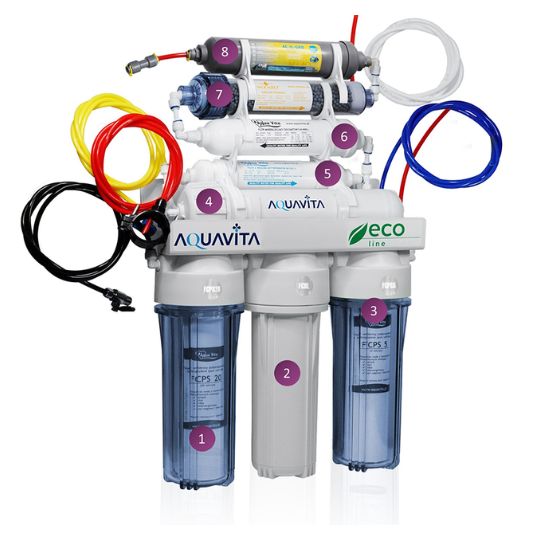
You need perfectly cleanWater for laboratory or aquarium purposes? Check out our reverse osmosis filters that remove up to 99% of impurities, restoring the natural parameters of water.
Practice: How to measure and use this knowledge?
Knowledge of density is useful not only for scientists.Here’s how you can apply this knowledge in practical home and technical use.
Specific heat of water and its density
The high specific heat of water (about 4186 J/kg·K) combined with its density makes water an excellent carrier of energy. However, when designing underfloor heating, you must remember that as the temperature increases, density decreases, and the volume of the liquid increases. If you do not take this into account when selectingthe pressure increase can damage the installation.
Mini-checklist: Identifying water quality issues
Often, changes in the "behavior" of water (e.g., slower flow, deposits) are confused with changes in its density. Here’s what to check in 2 minutes:
- Limescale: If the water feels "heavy" and leaves white marks, the issue is hardness, andnot density. The solution is water softeners.
- Temperature: If the heating pump is operating louder, check the return temperature. Water that is too hot (lower density and viscosity) can cause cavitation of the impeller.
- Clarity: Cloudy water may have altered local density due to suspensions. It is advisable to use filters.mechanical.
Common misconceptions about density
In conversations with customers, we often encounter myths. Here is a list of things to watch out for:
- Confusing density with viscosity: Just because water flows more slowly from a funnel doesn't mean it is denser. This could be the effect of a lower temperature (increased viscosity), rather than a change indensity.
- Ignoring temperature in measurements: When using a hydrometer (e.g., in aquaristics or brewing), you must correct the result for the temperature of the sample. A density measurement at 25°C will yield a different result than at 20°C, which can distort the reading of sugar or salt content.
- Ignoring pressure: Water is very slightly compressible, but in high-pressure hydraulic systems(przemysł) these minimal differences can be significant for precise dosing.
Practical conclusion: Always measure the density at the temperature to which your measuring device is calibrated (usually 20°C). Any deviation requires the use of a correction table.
Frequently Asked Questions (FAQ)
Does water always freeze at 0at degrees?
Under normal pressure conditions, yes, but pure water (without crystallization nuclei) can be supercooled and remain liquid even below 0°C. Additionally, water under very high pressure freezes at a lower temperature.
What is the density of ice and why is it less than that of water?
The density of ice is about 917 kg/m³. This is because the water molecules in the ice crystal are spaced further apart.a higher density than freshwater, creating empty spaces in the structure.
When does water have the highest density?
Water reaches its maximum density at a temperature of 3.98°C (often rounded to 4°C). At that point, it is 999.97 kg/m³.
Is saltwater denser than freshwater?
Yes, dissolved salt increases the mass of the solution with a relatively small change in volume. Therefore, seawater hasgreater buoyancy.
Why check the water density in the heating system?
Density is not measured directly, but its changes affect pressure. Understanding thermal expansion (decrease in density = increase in volume) is crucial for selecting the appropriate expansion vessel.
Do water filters change its density?
Yes, but to a minimal extent. Systems such asreverse osmosis removes minerals, slightly reducing the density of water to the level of pure H₂O. Softeners replace calcium ions with sodium, which also has a marginal effect on physical density.
Sources:
- https://pl.wikipedia.org/wiki/Woda - Physical and chemical properties of water (basic data).
- https://isap.sejm.gov.pl/ - Standards for the quality of water intended forconsumption (context of pollution).
- https://encyklopedia.pwn.pl/haslo/woda;3997251.html - PWN Encyclopedia, entry: Water (density anomaly verification).
