
- There are no more items in your cart
- Shipping
- Total 0.00 zł



Reverse osmosis - reject and water consumption
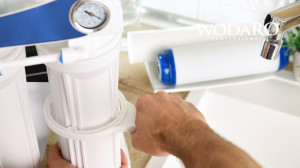
If you are considering purchasing a reverse osmosis system, you are probably wondering how much water reverse osmosis wastes and whether it really has a significant impact on the environment and your budget. In this article, we will clear up your doubts and discuss in detail the issues related to waste and water consumption in filtration systems.
In this article, you will learn
- What is water wastein the reverse osmosis process.
- What contaminants are present in the rejected water.
- What does water consumption in an RO system depend on.
- How much water do different types of reverse osmosis systems consume.
- How to reduce water consumption and reusereject.
Reverse osmosis – what is water reject?
First, we need to clarify a key issue – what does rejected water mean? Rejected water is the part of the water that does not pass through the osmotic membrane during the purification process. The osmotic membrane, functioning on the principle of semi-permeability, allows only water molecules and some trace elements to pass through, while retainingpollution.
The ratio of treated water to rejected water indicates how many liters of water are used to obtain one liter of clean water. Typically, in simple systems, this ratio ranges from 1:4 to even 1:8, which means that to obtain 1 liter of clean water, 4-8 liters are discarded as waste. Such water is no longer suitable for drinking without additional treatment, as it contains concentrated pollutants.
It is worthRejected water is the liquid that did not pass through the membrane, and its main purpose is to carry away contaminants so they do not accumulate on the surface of the filter. What contaminants are present in the rejected water? The water rejected by the reverse osmosis system contains contaminants removed from the filtered tap water. These include:
- heavy metals (iron, manganese, arsenic),
- mineral salts (calcium, magnesium),
- nitrates,
- chlorine and its compounds,
- organic compounds (pesticides, detergents),
- bacteria and viruses (to a lesser extent).
What does water consumption in reverse osmosis depend on?
Water consumption byThe reverse osmosis system depends on many factors. The most important of these are:
- Water pressure in the network – the higher the pressure, the lower the rejection and greater filtration efficiency.
- Quality of the input water – the more contaminants, the greater the water consumption, as the membrane clogs faster.
- Temperaturewater – cold water increases rejection because flow through the membrane is hindered.
- Water intake amount – with short and frequent filtration cycles, water rejection increases.
- Membrane condition – regular replacement and maintenance of the membrane positively affects the reduction of rejection.
Reverse osmosis – how much water does it consume?Examples
Standard reverse osmosis equipped with a tank, under average water quality and pressure of about 4 bars, generates a waste ratio of 1:4 to 1:5. This means that for every liter of pure water obtained, you lose 4-5 liters of water.
Modern tank systems with a built-in pump, using high-efficiency membranes (400-800+ GPD), achieve significantly better results. In these systems, the ratio can range from 1:1 to 1:2, regardless ofnetwork pressure.
The standard range for tank systems is from 1:3.5 to even 1:8. It is important to remember that improper connection or lack of regular maintenance can further worsen this ratio.
Example water consumption:
- Classic tank system (ratio 1:5): To obtain 5 liters of pure water, you will consume about 25 liters, and the waste will be about20 l.
- Modern with pump (ratio 1:2): To obtain 5 l of pure water, you will use about 15 l, and the waste will be about 10 l.
- Very efficient system (ratio 1:1): To obtain 5 l of pure water, you will use about 10 l, and the waste will be about 5 l.
- Malfunctioning/misconfigured system (ratio 1:8): To obtain 5 l of pure water,you will use about 45 l, and the reject will be about 40 l.
Reverse osmosis filter – how to reduce water consumption?
If you want to limit water reject, you can implement several significant improvements. The most effective methods are:
- Improvement of the incoming water quality – installation of additional pre-filters on the main valvewater.
- Increasing water pressure – installing a pressure-boosting pump significantly contributes to reducing the amount of reject water. The increase in pressure leads to more efficient membrane operation.
- Regular maintenance – replacement of pre-filters and periodic membrane inspection.
Can the rejected water be reused?use?
Definitely yes! Although rejected water is not suitable for drinking without additional treatment, you can successfully use it in your household:
- for watering the lawn and garden plants (if it does not contain large amounts of salt),
- for flushing the toilet,
- for washing vehicles, paving stones, or terraces,
- for purposeseconomic, e.g. washing tools or garden equipment.
Water rejection in osmosis – summary
Water rejection is an integral part of the filtration process using reverse osmosis. Although it may seem disadvantageous at first glance, it can be significantly reduced in practice. Remember that water consumption depends on many factors, including water quality, pressure, and the type of system you have. Regular maintenance,Improving the quality of the incoming water and installing a pressure-boosting pump significantly contributes to reducing waste, which positively impacts both the environment and your budget.
In summary, reverse osmosis systems have a significant impact on the quality of the water we drink, and conscious waste management allows for the ecological and economical use of every liter of water.
Recommendedproduct:
You can find all products in the "Reverse Osmosis" category in our store
Frequently Asked Questions (FAQ)
Is reverse osmosis water healthy?
Yes, it is one of the purest forms of water, free from heavy metals and contaminants. However, it is important to remember about its remineralization to provide the body with essential minerals.
Does every RO system waste the same amount of water?
No. The consumption depends on many factors, such as pressure, water quality, and membrane condition. Modern systems with a pump are significantly more efficient.
Can I use the rejected waterDrink?
No, the rejected water contains concentrated contaminants and is not suitable for drinking without additional treatment.

