
- There are no more items in your cart
- Shipping
- Total 0.00 zł




How does a water filter work?
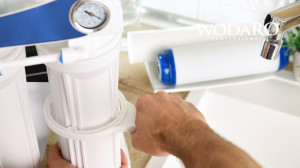
The filter is an essential device for obtaining water that meets the appropriate safety standards and is thus suitable for consumption. There are many types of this equipment, each with slightly different properties that allow for various applications. The key to choosing the right filter is to thoroughly test the water in order to match it to its parameters. In the face of growing ecological awareness and the need for access to clean water,Water filters are becoming increasingly popular in households.
Last updated: August 26, 2025
In this article, you will learn…
How do mechanical filters work?
Mechanical filters, such as string filters (using polypropylene string wound onThe core of the string) and foam (having a multi-layered, foam structure) trap contaminants through micropores, the diameter of which decreases towards the inside. As a result, larger particles are trapped at the beginning, while smaller ones are captured at a later stage. Mechanical filters allow for effective removal of rust, sludge, or sand.
How do filters workharmony filters?
Harmonic filters include carbon, deionizing, and softening models. In their case, contaminants are trapped by a cartridge that captures particles larger than the pores. Harmony filters are reusable equipment.
It's worth remembering: Mechanical filters are the basic solution forwater purification, which supports further filtration processes.
In carbon filters, as the name suggests, activated carbon is used, which has excellent sorptive properties. As a result, substances such as chlorine, lead, and heavy metals are effectively removed from the contaminated water that flows through such a cartridge. Additionally, the liquid gains a better smell and taste.
Iron removal filters effectively eliminate iron ions. This is achieved through the use of a catalytic bed. By using an iron removal filter, problems such as yellow stains on clothes, brown streaks on sanitary devices, and metallic taste and smell in water will disappear once and for all.
Water softening filters work similarly to carbon or iron removal models; however, in their case, the filtrationion exchange resin responds. Thanks to its ability to absorb calcium carbonate, the water becomes soft, and the troublesome problem of limescale buildup on household appliances ceases to exist.
Types of water filters
There are many types of water filters available on the market, including mechanical filters, accordion filters, reverse osmosis filters, softening filters, anddeionizing. Each of them has its unique properties and applications, which makes choosing the right filter a challenge. It is worth paying attention to the water parameters we want to filter in order to select the appropriate type of filtration.
Reverse osmosis filters are advanced devices that effectively remove not only mechanical impurities from water but also chemical contaminants, viruses, and bacteria. Thanks to the use of a membraneOsmotic, this process is extremely efficient, making it one of the best methods for water treatment.
It's worth remembering: Pleated filters are an ideal solution for those looking for long-term and effective water filtration solutions.
How to choose a water filter?
The choice of the right water filter should depend on the quality of the water we have in our home. It is recommended to conduct a water analysis to accurately determine what contaminants are present. Based on this, one can decide whether a mechanical filter, a pleated filter, or perhaps a more advanced reverse osmosis system would be a better solution. It is also worth considering the operating costs and the availability of replacement cartridges.filtration.
Remember, clean water is essential!
Frequently Asked Questions (FAQ)
What are the most common contaminants in water?
The most common contaminants are bacteria, viruses, heavy metals, chlorine, and mechanical impurities.
How oftenShould filter cartridges be replaced?
The frequency of cartridge replacement depends on the type of filter and the quality of the water, generally every 6-12 months.
Are water filters expensive to operate?
The operating costs of filters depend on their type and the frequency of cartridge replacement, but in the long run, they can be beneficial.
What are the benefits of using filters forwater?
Water filters improve water quality, eliminate contaminants, and enhance taste and smell.
Are mechanical filters sufficient for purifying water?
Mechanical filters are effective in removing mechanical impurities, but for complete protection, it is advisable to use additional filtration methods.
What are the best filters for water?drinking?
The best drinking water filters are those that effectively remove both mechanical and chemical contaminants, such as reverse osmosis filters.
Author: Maciej Waliduda — a specialist in water filtration, with many years of experience in the industry. He helps in selecting appropriate solutions for clients.individual and business.
