
- There are no more items in your cart
- Shipping
- Total 0.00 zł





Filtration accuracy in mechanical filters
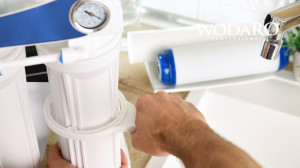
Available mechanical filters on the market differ in their parameters. One of them is the number of microns. What does this term mean? What impact does it have on water filtration? Which filters are the best? You will find all this information in our post!
Last updated: August 26, 2025
In this article, you will learn…
What isis a micrometer/micron?
At the very beginning, it is worth explaining what a micron actually is. In short, it is a small unit of measurement that measures length. It is also known as a micrometer and is denoted by the symbol μm. Since it represents a submultiple of a meter, it is equal to 1/1,000,000 of a meter or 1/1,000 of a millimeter.
It is worth remembering: A micron isthe key unit of measurement in the context of filtration, as it allows for the precise determination of the sizes of contaminants that a given filter can capture.
How many microns should a water filter have?
To best illustrate the size of a micrometer, it is worth using an example. Human hair has varying thicknesses, but it can be assumed that they containin the range of 30 to 120 microns. In the case of contaminants present in water, these values are significantly lower – for example, staphylococcus bacteria are about 0.7 microns.
The conclusion is therefore simple – the fewer microns a water filter has, the greater its accuracy.
It is worth remembering: Choosing a filter with the appropriate number of microns is crucial.for the effectiveness of water filtration, especially in the context of eliminating fine contaminants.
Mechanical water filter – the most popular types
Mechanical filters can be divided into several groups. Their size and type of connections depend on the demand and the expected filtration efficiency. This division is as follows:
- mechanical filters with replaceable reusable cartridges – these are usually larger pipe filters that can be adapted to the type of contaminants present. They use durable filter meshes that do not require the sleeves to be replaced each time. The reusable cartridges only need to be removed from the housing, rinsed, and reinstalled;
- mechanical filters withwashed mesh – are characterized by high durability due to the use of a filter mesh made most often of steel. To function correctly, the valve should be periodically unscrewed to remove contaminants. This type of filter is most often chosen to protect the home installation in case of a water supply network failure;
- pipe filter housings – a budget solution that allows for the retention of mechanical contaminants.To work efficiently, they should be replaced periodically. The most commonly used cartridges are made of polypropylene non-woven fabric wound in the form of string or foam.
How to choose a mechanical filter?
Choosing the right mechanical water filter should be thoughtful and based on several key criteria. First of all, it is worthpay attention to the type of contaminants present in our water. Depending on whether we are dealing with sand, silt, or fine organic particles, we choose the appropriate filter. Secondly, the filtration efficiency is crucial and should meet our needs. Lastly, but no less important, is the ease of maintenance of the filter, which will affect its longevity andefficiency.
It's worth remembering: The choice of the appropriate type of mechanical filter should be tailored to the specifics of the contaminants in the water and the individual needs of the user.
It's also worth familiarizing yourself with user reviews and filter tests, which can provide valuable information abouteffectiveness of individual models.
Author: Maciej Waliduda - specialist at MojaWoda.com
Frequently Asked Questions (FAQ)
What are the main advantages of mechanical filters?
Mechanical filters effectively remove mechanical impurities, which improves water quality and protects the installation.hydraulic.
Are mechanical filters easy to install?
Most mechanical filters are designed for easy installation, allowing users to install them without difficulty.
How often should filter cartridges be replaced?
The frequency of replacing filter cartridges depends on their type and the level of water contamination, but it usually ranges fromfrom a few weeks to a few months.
Do mechanical filters eliminate bacteria?
Mechanical filters mainly remove mechanical impurities, but they are not effective in eliminating bacteria and viruses, so it is worth considering additional disinfection methods.
What are the differences between mechanical and carbon filters?
Mechanical filters remove physical impurities,while carbon filters eliminate chemical contaminants and improve the taste of water.
Can mechanical filters be used in osmotic systems?
Yes, mechanical filters can be used as a preliminary safeguard in osmotic systems, protecting membranes from contaminants.
