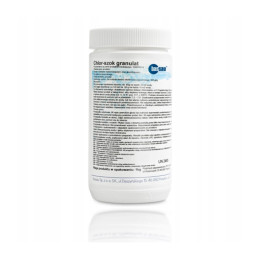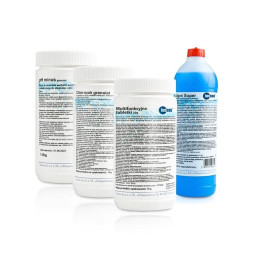
How much shock chlorine should you add to a pool? If you use the granular shock chlorine available from MojaWoda, use 8 g for every 1 m³ of water when filling the pool for the first time. For a 10 m³ pool, this is 80 g; for 20 m³, 160 g; and for 30 m³, 240 g.
The manufacturer also recommends periodic chlorination at a dose of 3,5 g per 1 m³, which is 35 g per 10 m³. These are not two doses that need to be added together. The first is used to treat freshly filled water, while the second is for periodically refreshing the pool during the season.
The dosage below applies to the specified product containing 56% active chlorine. If you have a different product, check its label – stronger granules may require a smaller amount.
Table of contents
- Doses for 1, 10, 20 and 30 m³
- What should you check before chlorinating?
- Shock chlorination step by step
- How do you calculate pool capacity?
- What should you do with green or cloudy water?
- When can you swim?
- Why did chlorination not work?
- Key safety rules
- Frequently asked questions
How much shock chlorine for 1, 10, 20 and 30 m³?
First, choose the situation that applies to your pool:
- First fill – when the pool has just been filled with fresh water.
- Periodic chlorination – an additional treatment carried out every 2–3 weeks while the pool is in use.
| Amount of water | First fill | Periodic chlorination |
|---|---|---|
| 1 m³ / 1000 litres | 8 g | 3,5 g |
| 10 m³ / 10 000 litres | 80 g | 35 g |
| 20 m³ / 20 000 litres | 160 g | 70 g |
| 30 m³ / 30 000 litres | 240 g | 105 g |
Simply put: if you have just filled a 10 m³ pool, use 80 g of the product. If you are carrying out additional chlorination during the season, use 35 g.
The periodic dose may not always be enough to clean a heavily green pool. In this situation, first measure the pH and chlorine level, remove visible debris, brush the walls and start filtration.
What should you check before adding chlorine?
Complete three simple steps before chlorinating.
1. Check how much water is in the pool
The dose is calculated based on the actual amount of water, not the total capacity stated in the pool name. If the manufacturer specifies the usable capacity, use that value.
2. Measure the pH
For the product described, the recommended pH is 7,0–7,4. If the pH is too high, chlorine works noticeably less effectively. You may therefore add the correct amount of product while the water still does not look right.
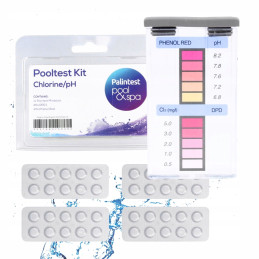
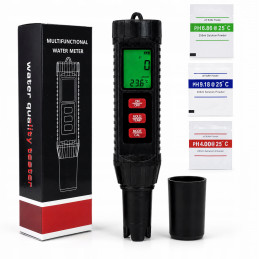
You can use test strips, a drop test kit or a photometer to check pH. Suitable devices can be found in the pool water testers category.
If the pH is too high or too low, first use the appropriate pH regulator. Once the water has mixed, take another measurement and only then add chlorine.
3. Measure free chlorine
Free chlorine is the part of chlorine that actually disinfects the water. The measurement will show whether its level is zero, too low or still adequate. This means you will not be adding the product by guesswork.
How do you shock chlorinate a pool?
1. Remove dirt from the pool
Skim out leaves and insects, vacuum the bottom, and brush slippery walls. Chlorine should not be wasted on dirt that can be removed with a net or vacuum cleaner.
2. Clean the filter
Backwash the sand filter or clean the cartridge filter. Dead algae and fine dirt will collect in the filter after chlorination, so it must be unobstructed.
3. Start the pump
The pump should run while you add the product. This allows the chlorine to mix quickly with the water and prevents it from remaining in one spot.
4. Measure the dose
Use the table above or calculate the quantity proportionally. For example, when filling a 15 m³ pool for the first time, you need:
15 × 8 g = 120 g of product
It is best to use kitchen scales or the measuring scoop included with the packaging. In a small pool, even a difference of several grams can significantly affect the final result.
5. Add the product in the evening
It is best to add chlorine after sunset. During the day, sunlight accelerates its breakdown, so some of the product may be unnecessarily wasted.
The method of application depends on the specific product. If the granules need to be dissolved first, use a clean plastic bucket. First pour water into it, then slowly add the product and stir.
Do not leave granules on the bottom, steps or pool liner. A large amount of chlorine concentrated in one place can discolour the surface.
6. Leave the filtration running
After normal chlorination, the pump should run for around 8–12 hours. If the water was green or heavily contaminated, filtration may be needed for a full day.
Check the filter during this time. If it becomes dirty quickly, rinse or clean it and restart circulation.

Not sure how much product to add? Prepare information about the pool capacity, a photo of the label, and the pH and free chlorine results. Contact us – we will help you select the right dose.
How do you calculate pool capacity?
If you do not know the exact capacity, you can calculate it from the pool dimensions.
| Pool shape | How do you calculate the capacity? |
|---|---|
| Rectangular | length × width × water depth |
| Round | 3,14 × radius × radius × water depth |
| Oval | length × width × water depth × 0,785 |
A rectangular pool measuring 5 m long, 3 m wide and with a water depth of 1,2 m has a capacity of:
5 × 3 × 1,2 = 18 m³
If the bottom is uneven, use the average depth. Add the minimum and maximum depth, then divide the result by two.
Where does the 90 g per 10 m³ dose mentioned in some guides come from?
This is a mathematically calculated amount that should raise the free chlorine level by around 5 mg/l. It is not an additional dose to be added to the 80 g stated on the label.
The difference between 80 and 90 g is small and results from two different ways of determining dosage. For the average user, the simplest solution is to use the dose specified by the manufacturer and then test the water with a tester.
How do you adjust chlorination to the appearance of the water?
Freshly filled pool
Set the pH to the correct level, add the dose intended for the first fill and leave the filtration running. Once the water has mixed, check the chlorine level.
Green water and slippery walls
Green water and a slippery coating usually indicate algae growth. In this situation, simply adding chlorine may not be enough. You also need to brush the walls and bottom and leave the filtration running.
Detailed instructions can be found in the guide green pool water – how to clean it.
An algaecide can support cleaning, but do not mix it with chlorine in one bucket. Add both products separately, at the interval stated on the packaging.
The water turns brown or yellow after chlorination
This often occurs after filling the pool with well water. Chlorine oxidises the iron present in it, causing the water to change colour, and a rusty deposit may appear later.
This does not mean you need to add more chlorine immediately. Filtration and regular filter cleaning are the most important things at this point.
The water is milky after chlorination
A milky colour often comes from dead algae and fine contaminants suspended in the water. The chlorine has done its job, but the filter needs time to remove the remaining suspension.
The cause may also be incorrect pH or mineral deposits. Find more information in the guide milky pool water – causes and solutions.
If the filter cannot handle very fine suspended particles, you can use a pool coagulant. Before buying, however, check whether the product is suitable for your type of filter.
The water smells strongly of chlorine
An intense “pool” smell does not necessarily mean there is too much chlorine. It is often caused by combined chlorine, which forms when chlorine comes into contact with sweat, cosmetics and other contaminants.
In this situation, smell alone is not enough to assess the water. A measurement of free and total chlorine is required.
Which test results are most important?
| Parameter | What does it show? |
|---|---|
| pH | Whether the water has the correct pH. A pH that is too high weakens chlorine performance. |
| Free chlorine | How much chlorine can still disinfect the water. |
| Total chlorine | The total amount of free and combined chlorine. |
| CYA stabiliser | Protects chlorine from sunlight, but weakens its performance when present in excess. |
For routine pool monitoring, measuring pH and free chlorine is usually sufficient. Total chlorine is worth checking when the water smells strongly, stings the eyes or quickly loses clarity.
The CYA stabiliser level is mainly important if you have been using stabilised chlorine for many weeks. CYA builds up in the water and is not removed by a normal filter. If there is too much of it, chlorine may work poorly despite an apparently good tester result.
When can you swim after chlorination?
After shock chlorination, you usually wait 8 to 24 hours, but time alone does not guarantee that it is safe to enter the water.
Before swimming, check that:
- the free chlorine level has returned to the range recommended by the manufacturer;
- the pH is correct;
- the water is clear and the bottom is clearly visible;
- there are no undissolved granules on the bottom.
If the chlorine level is still high after 12 hours, wait longer. This depends largely on the dose, sunlight exposure, temperature and the amount of contaminants in the water.
What should you do if there is too much chlorine?
Leave the circulation running, remove the cover and allow the chlorine to break down gradually. Test the water regularly and do not use the pool until the reading returns to a normal level.
If the concentration is very high, you can partially replace the water or use a carefully measured chlorine neutraliser. Do not add neutraliser pre-emptively, as too much may remove all chlorine from the water.
Why did shock chlorination not work?
| What is happening? | Possible cause | What should you do? |
|---|---|---|
| The tester still shows zero after treatment | The chlorine was quickly used up by a large amount of contaminants, the product is old, or the tester is giving an incorrect result. | Clean the pool, check the tester and measure again. |
| The water is still green | Incorrect pH, dirty walls, poor filtration or too much stabiliser. | Adjust the pH, brush the pool and leave the filtration running for a full day. |
| The water has become milky | Dead algae or fine sediment are suspended in the water. | Continue filtration and clean the filter regularly. |
| Chlorine remains very high for a long time | Too much product was added, or the water was clean and used very little chlorine. | Do not add more chemicals. Circulate the water and monitor the level with a tester. |
| Light spots have appeared on the liner | Undissolved granules were left directly on the surface. | Distribute the product more thoroughly during the next chlorination. |
| Algae return after a few days | There is no regular disinfection, filtration runs for too short a time, or the CYA level is too high. | Test the water regularly and check the operation of the pump and filter. |
Is every shock chlorine dosed in the same way?
No. Products differ in composition and concentration. Therefore, the correct dose for one product may be too high or too low for another.
| Product type | What is worth knowing? |
|---|---|
| Fast-acting granules | They work quickly and are easy to measure. The exact dose depends on the concentration stated on the packaging. |
| Calcium hypochlorite | It does not increase the stabiliser level, but adds calcium to the water. In hard water, it may increase deposit formation. |
| Liquid chlorine | It works quickly, but loses strength over time, especially when stored in warmth or sunlight. |
| Slow-dissolving 200 g tablets | They are mainly used to maintain chlorine levels regularly. They do not replace fast shock chlorination. |
You can compare available products in the pool chlorine category.
Most common mistakes
- Adding the product without checking the pool capacity.
- Adding chlorine without measuring pH first.
- Using dosage intended for a different product.
- Adding chlorine and pH Minus at the same time.
- Leaving granules on the bottom or pool liner.
- Chlorinating with the pump switched off.
- Skipping brushing of the walls when the water is green.
- Assessing the chlorine level solely by its smell.
- Entering the water without taking a measurement after treatment.
Key safety rules
- Wear gloves and avoid inhaling dust.
- Use a separate, clean and dry measuring scoop.
- Do not mix chlorine with other chemical products.
- Do not combine different types of chlorine in a bucket, skimmer or dispenser.
- If preparing a solution, pour in the water first and only then add the granules.
- Store the packaging in a dry, cool place out of reach of children.
- Do not use the pool during chlorination.
More information about essential products can be found in the guide what pool chemicals to buy to get started.
How often should shock chlorination be carried out?
For the specified product, the manufacturer recommends additional chlorination every 2–3 weeks. The treatment may be needed sooner if:
- many people have used the pool;
- the free chlorine level has dropped to zero;
- a storm has introduced a lot of dirt into the water;
- the filtration has not been working for a long time;
- algae or a slippery coating has appeared.
There is no need to carry out strong chlorination every weekend if the water is clear and the readings are correct. During hot weather, it is better to check pH and chlorine more frequently than to have to rescue the entire pool later.
Frequently asked questions
Do you need to dissolve shock chlorine in a bucket?
It depends on the specific product. If the manufacturer recommends dissolving it first, use a plastic bucket. First pour in the water, then slowly add the granules.
Should the pump run during chlorination?
Yes. A running pump distributes the product evenly throughout the pool and directs contaminants into the filter.
Can you swim after 12 hours?
Only if the measurement shows a correct chlorine level and pH, and the water is clear. After a larger dose, the waiting time may be longer.
Does a strong smell mean there is too much chlorine?
Not always. An intense smell often comes from chlorine combined with contaminants. The chlorine level should be checked with a tester.
Can chlorine and algaecide be added together?
Do not mix them in one container or pour both concentrates into the same place. Add them separately, observing the interval stated on the packaging.
Does chlorination change pH?
It can change pH, so it is worth taking another measurement once the treatment is complete.
Key information at a glance
For the first fill, use 8 g of product for every 1 m³ of water. For periodic chlorination, use 3,5 g per 1 m³. Before treatment, check the pH, clean the pool and start the pump. It is best to add chlorine in the evening, and test the water before swimming again.
More information about how chlorine works can be found in the guide chlorine – what it is and how it works.
Sources
Author: Maciej Waliduda
Last updated: 2026-07-21.