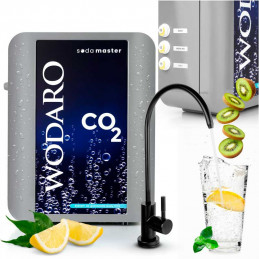
In most apartments, an under-sink filter works best. However, the type of unit should be selected based on the result you expect. If the taste or smell of chlorine bothers you, a carbon filter is usually sufficient. If you also want highly thorough purification and less limescale in the kettle, reverse osmosis will be the better choice. In contrast, limescale on taps, in the shower and in the washing machine requires a water softener installed at the water inlet — provided that the apartment's plumbing layout allows it.
There is no single filter suitable for every apartment building. Particles from old pipes require one solution, hard water another, and an unpleasant tap water taste yet another. Before buying, it is also worth checking several practical aspects: the amount of space under the sink, water pressure, access to a drain and power socket, and the way hot water is supplied.
If you are looking for a kitchen unit, see under-sink water filters. Before choosing a specific model, use the table and installation checklist below.
Table of contents
- Which water filter for an apartment building? Quick selection
- Match the filter to the problem and expected result
- Does tap water in an apartment building need filtering?
- What should you check in the plumbing?
- Comparison of filters for apartments
- Which under-sink filter should you choose?
- Reverse osmosis in an apartment building
- A filter or softener for the entire apartment
- Pre-purchase checklist
- Costs and filter cartridge replacement
- A filter in a rented apartment
- Common mistakes
- Choosing a filter step by step
- Frequently asked questions
Which water filter for an apartment building? Quick selection
Start by determining exactly what you want to change. This is much more important than the number of filtration stages or the size of the housing.
| What bothers you? | Most often the right choice | What should you remember? |
|---|---|---|
| Chlorine taste or smell | a carbon faucet filter or under-sink filter | activated carbon alone does not remove hardness |
| Sand, rusty flakes or other particles | a sediment filter; for the whole apartment — at the water inlet | if the change occurred suddenly for many residents, report it to the building management first |
| Unpleasant-tasting water for drinking and cooking | a mechanical-carbon or ultrafiltration under-sink filter | the result depends on the type and quality of the cartridges used |
| Limescale in the kettle and coffee machine | reverse osmosis or a filter with ion-exchange resin | a kitchen filter will not protect the shower, washing machine or fittings |
| A need for highly thorough drinking water purification | a reverse osmosis system | requires a drain connection, and some models also require electricity |
| Limescale throughout the apartment | a compact water softener at the water inlet | requires a drain, electricity, space for salt and the right pipe layout |
The most common mistake? Choosing good technology for the wrong task. A carbon filter will not remove limescale, an under-sink RO system will not protect the bathroom, and a water softener will not replace a filter that improves drinking water taste.
First the problem and expected result, then the unit
Simply saying “I want cleaner water” does not tell you much. You need to establish what bothers you about the tap water and whether the change should apply only to drinking water or to the entire plumbing system.
| Symptom | Possible cause | What should you do first? |
|---|---|---|
| distinct chlorine taste or smell | chlorine used to disinfect water | use an activated carbon filter |
| white residue in the kettle | hard water, mainly calcium and magnesium compounds | measure hardness; for drinking water, consider RO or a resin cartridge |
| limescale on the shower enclosure, taps and heating elements | hard water in the entire apartment plumbing system | check whether a water softener can be installed |
| sand, rusty flakes or other particles | sediment from the supply network or internal plumbing | check aerators, ask neighbours and review building management notices |
| metallic taste or unusual marks on fittings | the effect of pipes, taps or metals present in the plumbing system | have the water tested instead of buying a random filter |
| unpleasant smell only from hot water | hot water plumbing, a water heater or stagnant water | compare cold and hot water and report the matter to the building management |
You can initially measure water hardness with a drop or strip test. If the result is given in a unit you do not know, use the guide on how to check water hardness and convert units.
Does tap water in an apartment building need filtering?
Not always. Municipal water is treated and regularly monitored. In an apartment, a filter is most often installed to improve taste, retain sediment, reduce limescale in drinking water, or obtain more thoroughly purified water in the kitchen.
However, water quality at a particular tap is affected not only by the water supply network. The condition of the building's plumbing also matters: the age of the pipes, corrosion, accumulated sediment, rarely used sections and the fittings themselves. This is also noted by the Provincial Sanitary and Epidemiological Station.
First, check the current water utility report for your area. Consider testing a sample taken from the tap when:
- the taste, smell or colour of the water has suddenly changed and does not return to normal after flushing the plumbing,
- a concerning symptom occurs only in your apartment,
- the building has old plumbing or you do not know its condition,
- you suspect the presence of metals originating from pipes or fittings,
- the apartment has not been used for a long time.
If the water supplier or Sanitary Inspectorate has issued a notice prohibiting water consumption or requiring boiling, follow those recommendations. A home filter is not a substitute for them.
A TDS meter is not a water quality test. It shows conductivity and the approximate amount of dissolved substances, but it does not detect bacteria or identify the compounds in the sample. It is most useful for monitoring RO membrane performance.
What should you check in the apartment plumbing?
In a detached house, there is usually one main connection and a separate utility room. In an apartment building, the plumbing may be divided between several risers, and the kitchen and bathroom are not always supplied from the same pipe. Hot water may also be delivered through a separate riser.
Before choosing a filter, answer six questions:
- What do you want to filter? Drinking water only, or every outlet in the apartment?
- How many risers supply the apartment? A filter installed on one pipe will not cover outlets supplied by another riser.
- Where does the hot water come from? If it is supplied separately, a softener on the cold water line will not change its hardness.
- What is the pressure during water draw? When choosing RO, dynamic pressure — measured while the water is running — is what matters.
- Is there a drain and a power socket under the sink? Every RO system requires a drain, while units with a pump or Direct Flow also require power.
- Where is the boundary of the shared property? Installation near a riser or water meter may require approval from the building management.
A filter connected after a valve belonging to the apartment plumbing usually does not raise major concerns. Work on a riser, water meter or other shared components is different. In such cases, the rules depend on the particular building.
Types of water filters for an apartment — comparison
The installation location alone does not determine how a filter works. Under the sink, there may be a simple carbon set, an ultrafiltration membrane or a full reverse osmosis system. Each of these solutions delivers a different result.
| Solution | What does it reduce? | Does it reduce hardness? | Installation and limitations |
|---|---|---|---|
| filter jug | chlorine and unwanted taste and odour; some cartridges also reduce sediment | partially and for a limited time, depending on the cartridge | requires no installation, but has a low capacity and must be refilled regularly |
| faucet filter | chlorine, unwanted taste and fine sediment | usually not | easy to remove, but does not fit every tap |
| mechanical-carbon under-sink filter | sediment, chlorine and compounds affecting taste and odour | no, unless the system contains ion-exchange resin | does not require a drain; needs space and a separate water outlet |
| ultrafiltration | very fine particles; combined with carbon, also chlorine and unwanted taste | does not remove most dissolved salts | does not produce reject water; accuracy depends on membrane parameters |
| reverse osmosis | a very broad range of dissolved substances and drinking water hardness | yes, to a very large extent | requires a drain; models with a pump also need electricity |
| inlet sediment filter | sand, rust and other solid particles | no | must be matched to the maximum flow rate throughout the apartment |
| ion-exchange water softener | calcium and magnesium ions responsible for limescale formation | yes | requires a drain, electricity, salt and an appropriate plumbing layout |
Do not choose a filter solely based on phrases such as “seven stages”, “membrane” or “activated carbon”. Check which components are actually in the unit and what each of them does.
Which under-sink water filter for an apartment building?
For most apartments, this is the most convenient option. The filter does not take up counter space and treats exactly the water you use for drinking, cooking and making coffee.
Carbon filter — when taste and chlorine are the issue
With compliant municipal water whose taste or smell simply does not suit you, a carbon filter will be the simplest choice. Activated carbon effectively reduces chlorine and some compounds affecting taste. However, it does not remove calcium or magnesium, so it will not solve the issue of limescale in the kettle on its own.
Ultrafiltration — more thorough filtration without removing minerals
An ultrafiltration membrane retains much finer particles than a standard sediment cartridge. Depending on pore size, it can also act as a barrier to some microorganisms. However, it does not remove most dissolved salts, so water hardness and the TDS reading remain at a similar level.
Reverse osmosis — when you expect broader performance
An RO system passes water under pressure through a semipermeable membrane. This significantly reduces the amount of dissolved salts, including compounds responsible for limescale formation. Filtered water is well suited for drinking, cooking, kettles and coffee machines.
However, remember that a unit installed under the sink works only in the kitchen. It will not soften water in the shower or washing machine. The design and operating principle of such a system are shown in the reverse osmosis diagram.
If you do not want to alter the plumbing under the sink, check faucet-mounted filters. Before buying, compare the thread type and spout shape. Pull-out taps and unusually designed models often require a different solution.
Reverse osmosis in an apartment building: tank or Direct Flow?
Both solutions use the same technology. They differ mainly in how water is delivered, the space they occupy and their power supply requirements.
| Feature | Tank RO | Direct Flow RO |
|---|---|---|
| Operation | the membrane gradually replenishes the water stored in the tank | water is filtered on demand |
| Space required | a separate filter housing and tank | usually one compact housing |
| Power supply | often unnecessary if the system has no pump | usually required |
| Water flow | strong until the tank supply is depleted | depends on membrane capacity, pump and pressure |
| Purchase price | usually lower | usually higher |
| Cartridges | often standard and readily available | more often made for a specific model |
If you have little space and want water filtered directly when drawn, see tankless reverse osmosis systems. Before buying, check all dimensions. The cabinet must leave room for pipes, valves and easy cartridge removal.
What does membrane capacity stated in GPD mean?
GPD is the number of US gallons a membrane can nominally produce per day under specified test conditions. One US gallon equals approximately 3,785 litres.
| Membrane | Nominal daily capacity | Nominal capacity per minute |
|---|---|---|
| 75 GPD | approximately 284 l | approximately 0,20 l |
| 100 GPD | approximately 379 l | approximately 0,26 l |
| 400 GPD | approximately 1514 l | approximately 1,05 l |
| 600 GPD | approximately 2271 l | approximately 1,58 l |
In everyday conditions, capacity will be lower than in the table. It decreases with low pressure, cold water, high mineral content and membrane wear. Even so, a classic 75 GPD system can easily serve a typical family because water is stored in the tank beforehand.
Pressure, pump and the amount of reject water
A classic RO system without a pump usually needs at least around 3 bar, although the requirements of the specific model are decisive. Pressure should be measured while water is flowing. With the taps closed, the result may look correct, while it may drop noticeably once water is turned on.
If the pressure is too low, it is better to choose a system with a pump. Read more about possible causes in the guide on low water pressure at the tap.
The amount of concentrate, meaning water directed to the drain, depends on the design of the unit, pressure, temperature, mineral content, membrane condition and flow restrictor. A modern system with a pump can achieve a ratio of around 1:1–1:2. A classic RO system without a pump, operating in poorer conditions, may use around 4–8 litres of water for every litre of purified water. We describe this in detail in the article how much water reverse osmosis uses.
Is a mineraliser necessary?
A mineraliser is not mandatory. It is an additional cartridge that changes the composition and taste of water after it passes through the RO membrane. Some people prefer remineralised water, while others choose a simpler setup without this stage. Available solutions can be found in the category of RO systems with mineralisation.
With compliant municipal water, a UV lamp is usually not needed in a kitchen filter. It is used for microbiological disinfection, but it does not remove hardness or dissolved chemical compounds. It is used primarily when indicated by a water test or a specific application.
A filter for the entire apartment — when does it make sense?
An under-sink filter treats only water drawn from a separate faucet or selected circuit. If you want to protect the washing machine, dishwasher, taps, aerators and shower, the unit must be installed at the appropriate water inlet to the apartment.
Sediment filter at the inlet
This is a good solution when sand, rust or other solid particles regularly appear in the plumbing. The filter protects fittings and downstream devices, but it does not reduce hardness or remove dissolved substances.
Do not choose the smallest or finest cartridge without checking flow rate. Too small a filtration area can quickly lead to a pressure drop. Connection diameter, cartridge type and maximum water draw in the apartment all matter. Available solutions can be found in the category of filters for the apartment water inlet.
Compact water softener
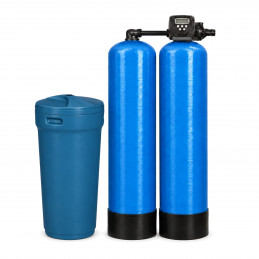
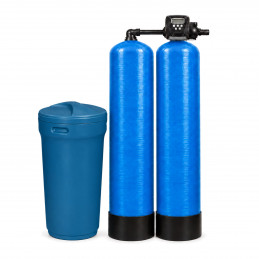
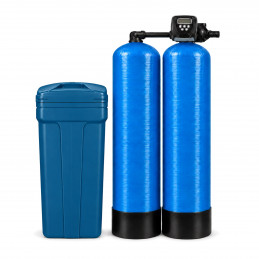
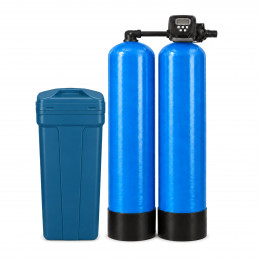
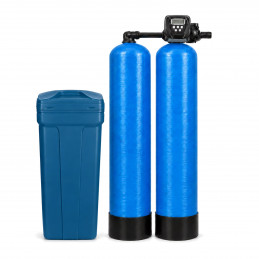
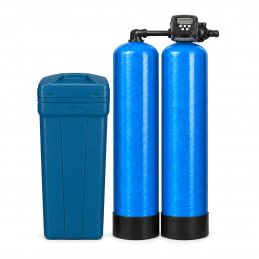
An ion-exchange softener is designed to reduce limescale throughout the entire plumbing system. It removes calcium and magnesium ions from water, replacing them with sodium ions. To operate, it requires a drain, power socket, space for salt, a service bypass and adequate flow.
The most important consideration in an apartment building concerns hot water. If it is supplied through a separate riser, a unit installed on cold water will not soften the water in the shower. The situation differs in an apartment with its own boiler or water heater — softening cold water before the unit then also covers the hot water produced from it.
Before buying, see water softeners for apartments and check whether the pipe layout actually allows you to achieve the expected result.
What should you check before buying? A 10-minute checklist
Many unsuitable purchases become apparent only during installation. A quick check of the cabinet and connections helps avoid returning the unit or modifying the plumbing.
| What should you check? | Why is it important? |
|---|---|
| Cabinet dimensions: width, height and depth | in addition to the filter, the trap, valves, bins and pipes must fit, while access to the cartridges must be retained |
| Cold water valve | before installation, it must work and shut off the water tightly |
| Dynamic pressure | affects RO capacity and determines whether a pump is needed |
| Drain access | an RO system must discharge concentrate to the drain |
| Power socket | it is required by the pump, Direct Flow system, electronics and UV lamp |
| Water dispensing method | you can use a separate filter faucet, a three-way tap or a suitable connection to the existing tap |
| Leak protection | in an apartment building, even a small leak can damage the unit below |
After installation, check all connections immediately, after a few hours and again the following day. Pipes must not be under tension, kinked or resting against sharp edges.
How much does a water filter for an apartment building cost and how often should cartridges be replaced?
The price of the unit alone does not show the full cost of use. You need to add cartridges, the membrane, possible servicing, water discharged by RO, energy and other consumable parts.
A simple comparison: annual cost = unit price divided by the intended period of use + cartridges + membrane + servicing + additional water and energy.
After two or three years, a cheaper filter may cost more than a more expensive model if it requires proprietary, hard-to-find cartridges. Before buying, check their price, availability and whether you can replace them yourself. You will find a broader comparison in the article is a water filter worth it.
| Component | Approximate service life | What accelerates wear? |
|---|---|---|
| sediment cartridge | around 3–6 months | a large amount of sediment, supply network works and a small cartridge surface area |
| carbon cartridge | around 6–12 months | high water use, high chlorine content and long periods of inactivity |
| resin cartridge | depending on capacity and water hardness | very hard water and high use |
| RO post-filter or mineraliser | usually 6–12 months | high use, stagnant water and cartridge quality |
| RO membrane | most often around 2–5 years | low pressure, worn pre-filters, limescale and high mineral content |
The stated intervals are approximate. The final schedule depends on water quality, use and filter design. After every replacement, flush new cartridges, check the connections for leaks and record the service date. Find more information in the water filter replacement schedule.
How do you check RO membrane performance?
Rejection can be calculated using the formula: (1 − TDS after RO ÷ TDS before RO) × 100%. With a result of 400 ppm before the membrane and 20 ppm after it, rejection is around 95%. It is best to take the measurement at a similar temperature and after the system has stabilised.
Which water filter for a rented apartment?
The simplest options are solutions that can be removed quickly: a filter jug, a compatible faucet filter or a countertop unit with its own tank. An under-sink filter can also be a reversible installation, as long as it does not require drilling or permanent plumbing alterations.
It is best to agree with the owner before replacing the tap, making a hole for a filter faucet or changing connections. When moving out, the installation should be restorable to its previous condition.
The most common mistakes when choosing a filter for an apartment building
| Mistake | What happens later? |
|---|---|
| choosing based on the number of stages | seven random cartridges do not necessarily work better than three well-selected ones |
| expecting carbon to remove limescale | water taste improves, but residue remains in the kettle |
| assuming an under-sink filter will protect the bathroom | a point-of-use filter works only on water drawn from its circuit |
| buying RO without measuring pressure | the system may filter slowly and discharge too much water to the drain |
| measuring only the unit housing | after installation, there is not enough space for pipes, valves or cartridge removal |
| treating TDS as a complete test | a low reading does not confirm the absence of bacteria or specific contaminants |
| overlooking cartridge costs | a cheap unit turns out to be expensive to maintain |
| trying to solve a fault with a filter | brown water affecting many residents must first be reported to the supplier or building management |
How to choose a water filter for an apartment building step by step?
- Define the goal. Is it about taste, chlorine, sediment, limescale in the kettle, thorough purification or protecting the entire apartment?
- Check the water. Start with the water utility report and a hardness measurement. Unusual symptoms may require laboratory testing.
- Check the plumbing. Determine the number of risers and how hot water is prepared.
- Measure installation conditions. Check the cabinet, dynamic pressure, drain, power socket and whether a filter faucet can be installed.
- Select the technology. Focus on the functions of the cartridges and membranes, not just the number of stages.
- Calculate the cost of use. Include cartridges, the membrane, water, energy and servicing.
- Ensure safe installation. You need a working valve, service access and preferably leak protection.
If you are still comparing several solutions, also read the guide which drinking water filter to choose.
FAQ — water filter for an apartment building
Which water filter is best for an apartment building?
For most apartments, an under-sink filter is the most convenient. A carbon filter works well for chlorine and unwanted taste, an ultrafiltration filter retains very fine particles, and reverse osmosis also significantly reduces dissolved salts and limescale in drinking water.
Which filter should you choose for hard water in an apartment building?
For drinking water, kettles and coffee machines, reverse osmosis or a suitably sized ion-exchange resin cartridge will work best. If limescale needs to disappear throughout the apartment, a softener installed at the correct water inlet is required.
Does a carbon filter remove limescale?
No. Activated carbon reduces chlorine and improves water taste and odour, but it does not remove calcium or magnesium. If a carbon cartridge reduces hardness, this is due to ion-exchange resin added to it.
Is reverse osmosis necessary for municipal water?
Not in every apartment. If only the taste of chlorine bothers you, a simpler carbon filter is enough. RO is worth choosing when you want highly thorough purification and a strong reduction of limescale in drinking water.
Does reverse osmosis need electricity?
A classic tank system can operate without electricity if plumbing pressure is sufficient. Pumps, Direct Flow units, electronics and UV lamps require power.
Do you need to drill a hole for an under-sink filter?
Not always. You can use an existing hole, install a three-way tap or add a separate filter faucet. In a rented apartment, drilling and tap replacement should be agreed with the owner in advance.
Which filter should you choose with low pressure?
A simple carbon or ultrafiltration filter usually has lower requirements than reverse osmosis. If pressure falls to around 3 bar or below, an RO system should have a pump.
Can a filter be installed at the apartment water inlet?
Yes, provided there is space for it, the unit has adequate capacity, and the installation does not interfere with the building's shared property. The filter will cover only outlets located after its connection point.
Can a water softener work in an apartment building?
Yes, if the plumbing allows it to be connected correctly. The unit requires a drain, electricity, space for salt and adequate flow. With hot water supplied through a separate riser, a softener on the cold water line will not cover it.
How often should filter cartridges be replaced?
Sediment cartridges are most often replaced every 3–6 months, while carbon cartridges are replaced every 6–12 months. An RO membrane can operate for several years. The exact interval depends on water quality, use and the manufacturer's recommendations.
What should you choose in practice?
If the main issue is the taste of tap water, start with a good carbon filter. If you want water with almost no limescale for the kettle and coffee machine, while also seeking more thorough purification, choose an RO system. If sediment appears throughout the plumbing, an inlet sediment filter will be suitable. A water softener makes sense when limescale also needs to disappear from the bathroom, washing machine and fittings.
Before selecting a unit, prepare information on water hardness, pressure, the number of household members, cabinet dimensions, how hot water is prepared and photos of the connections. This information will tell you much more about a filter's future performance than the number of stages stated on the packaging.

Not sure whether a carbon filter is enough or reverse osmosis would be better? Contact us — we will select a unit for your water, plumbing and the available space under the sink.
Sources
- Regulation of the Minister of Health of 22 May 2026 on the quality of water intended for human consumption.
- New regulations on the quality of water intended for consumption — Chief Sanitary Inspectorate.
- Information on municipal water quality and internal plumbing — Provincial Sanitary and Epidemiological Station in Warsaw.
- Characteristics of the quality of water intended for consumption — Provincial Sanitary and Epidemiological Station in Rzeszów.
Author: Maciej Waliduda — specialises in selecting domestic and industrial water treatment systems.
Last updated: 2026-07-16.