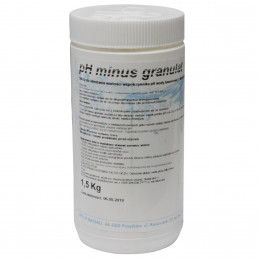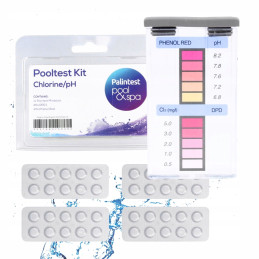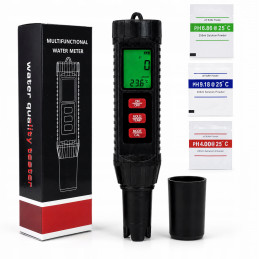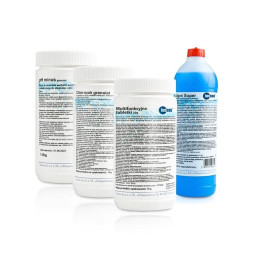
Lower excessively high pH with pH Minus and raise excessively low pH with pH Plus. In most chlorinated domestic pools, aim to keep the reading around 7,2-7,4. However, do not add the product by guesswork. The amount needed depends on pool volume, the current reading, planned adjustment, product concentration and water alkalinity.
In practice, a simple method works best: measure pH, calculate the dose according to the label, start circulation and test again once the water has mixed. Divide a large adjustment into two or three stages. This prevents overshooting and having to correct it in the opposite direction shortly afterwards.
In brief: use pH Minus when pH is above the recommended range, and pH Plus when it is too low. For many domestic pools, 7.2-7.4 is a good target. The table dose is a starting calculation; a repeat measurement determines whether another dose is needed.
Contents
- What should you do at a specific pH reading?
- What should pool pH be?
- How do you measure pH correctly?
- How do you calculate the dose of pH Minus or pH Plus?
- pH Minus dosing table
- pH Plus dosing table
- How do you adjust pH safely, step by step?
- Why does pH not fall, or rise again quickly?
- pH or chlorine first?
- When can you swim after adjusting pH?
- Calculation examples
- Common mistakes
- FAQ
Pool pH: what should you do at a specific reading?
If you already have a test result, the table below suggests where to start. The recommended range may vary slightly depending on the chemicals used, disinfection method and pool equipment, so also check the instructions for your products and units.
| pH reading | How should it be assessed? | What should you do? |
|---|---|---|
| Below 7.0 | pH too low | confirm the measurement, check alkalinity and use pH Plus according to the label |
| 7,0-7,1 | lower limit of the typical range | if the reading is stable and complies with the chemical instructions, adjustment may not be needed |
| 7,2-7,4 | a practical target for many domestic pools | do not add pH Minus or pH Plus |
| 7,5-7,7 | slightly above the optimum level | monitor the reading; a small adjustment is particularly useful before shock chlorination |
| 7.8 and above | pH too high | use pH Minus in stages; if the reading rises again, check TA/TAC |
What should pool pH be?
In a chlorinated domestic pool, the easiest approach is to keep pH within 7,2-7,4. You may also encounter wider ranges. The CDC specifies 7.0-7.8, the instructions for pH Minus granules available from MojaWoda state 7.0-7.4, and some pool equipment manufacturers allow 7.2-7.8.
There is no contradiction here. The wider range defines permissible operating conditions, while the narrower range makes effective chlorination and stable parameters easier to maintain. The recommendations on chemical packaging and in the installed equipment's instructions are most important.
What happens when pH is too high?
- chlorine disinfects less effectively; the decrease is particularly pronounced above pH 8.0,
- hard water is more prone to limescale and milky cloudiness,
- deposits may accumulate on the liner, nozzles, heater, chlorinator cell and in the filter,
- water may irritate the eyes and skin despite the correct disinfectant level.
What happens when pH is too low?
- water becomes more aggressive towards metal, grout, seals and equipment parts,
- it can accelerate corrosion of the ladder, heat exchanger and pump components,
- the risk of irritation increases,
- with low alkalinity, pH may change sharply after every chemical dose.
How do you measure pool water pH correctly?
Even the most accurately calculated dose will not help if the initial measurement is wrong. Take the sample away from the skimmer, return nozzle and any place where a product was recently added. Immerse the tester to the depth specified in its instructions. A measurement beside the dosing point shows a local chemical concentration, rather than the pH of the entire pool.
- Start circulation and allow the water to mix thoroughly.
- Take a sample from a representative location, not immediately beside a nozzle.
- Perform the test exactly according to the manufacturer's instructions.
- If the result is unexpected, repeat the measurement using a fresh test.
A drop or tablet test generally gives a more accurate reading than a strip. Strips are quick and convenient, but similar shades can be difficult to distinguish. An electronic pH meter gives a specific value, but only when regularly calibrated and its electrode is correctly stored. See the available pool water testers.
Two different results? This usually means the water has not finished mixing or one test was taken too close to the dosing point. Do not average the two readings. Let the pump run and test the water again.
How do you calculate the dose of pH Minus or pH Plus?
You need three figures to calculate the dose: actual water volume, current pH and the dosing instructions on the packaging. 1 m³ is 1000 litres. Do not calculate capacity solely from the dimensions in the pool's name. The water surface is below the top edge of the pool.
How do you calculate pool volume?
| Pool shape | Volume formula | What should you measure? |
|---|---|---|
| rectangular | length × width × average depth | water surface dimensions, not the external frame |
| round | 3.14 × radius² × average depth | water surface diameter and actual depth |
| oval | length × width × average depth × 0.785 | water surface dimensions |
Example: the water surface in a round pool has a diameter of 3.5 m, and the water is 0.65 m deep. The volume is therefore approximately 3.14 × 1.75² × 0.65 = 6.25 m³, or 6250 litres.
Universal dosing formula
If the label states that D grams per 10 m³ changes pH by 0.1, use the formula:
Dose [g] = (pool volume [m³] ÷ 10) × (required pH change ÷ 0.1) × D
If the manufacturer specifies a dose for a change of 0.2, scale it proportionally. Measure liquid products in millilitres – without knowing the density, you cannot assume that 1 ml equals 1 g.
pH Minus dosing table
The values below apply to a product dosed at 1.5 kg per 100 m³ of water to lower pH by approximately 0.2. This converts to 75 g per 10 m³ for an adjustment of approximately 0.1. This is the dosing rate of pH Minus granules available from MojaWoda.
Before using the table, compare the dosing instructions with the packaging. If they differ, use the formula above. Divide a larger calculated dose into stages.
| Water volume | Decrease of 0.1 | Decrease of 0.2 | Decrease of 0.3 |
|---|---|---|---|
| 1 m³ / 1000 l | 7.5 g | 15 g | 22.5 g |
| 3 m³ / 3000 l | 22.5 g | 45 g | 67.5 g |
| 5 m³ / 5000 l | 37.5 g | 75 g | 112.5 g |
| 8 m³ / 8000 l | 60 g | 120 g | 180 g |
| 10 m³ / 10 000 l | 75 g | 150 g | 225 g |
| 15 m³ / 15 000 l | 112.5 g | 225 g | 337.5 g |
| 20 m³ / 20 000 l | 150 g | 300 g | 450 g |
| 30 m³ / 30 000 l | 225 g | 450 g | 675 g |
| 50 m³ / 50 000 l | 375 g | 750 g | 1125 g |
The table shows doses obtained by a straightforward conversion of the instructions. The effect in a pool may differ slightly because total water alkalinity strongly affects pH changes.
pH Plus dosing table
For pH Plus, no single figure fits every product because formulations and concentrations differ. In the table, D is the label dose for 10 m³ of water to raise pH by 0.1.
| Water volume | Increase of 0.1 | Increase of 0.2 | Increase of 0.3 |
|---|---|---|---|
| 1 m³ / 1000 l | 0.1 × D | 0.2 × D | 0.3 × D |
| 3 m³ / 3000 l | 0.3 × D | 0.6 × D | 0.9 × D |
| 5 m³ / 5000 l | 0.5 × D | 1 × D | 1.5 × D |
| 8 m³ / 8000 l | 0.8 × D | 1.6 × D | 2.4 × D |
| 10 m³ / 10 000 l | 1 × D | 2 × D | 3 × D |
| 15 m³ / 15 000 l | 1.5 × D | 3 × D | 4.5 × D |
| 20 m³ / 20 000 l | 2 × D | 4 × D | 6 × D |
| 30 m³ / 30 000 l | 3 × D | 6 × D | 9 × D |
| 50 m³ / 50 000 l | 5 × D | 10 × D | 15 × D |
How do you read the table? Suppose the manufacturer recommends 100 g per 10 m³ to raise pH by 0.1. For a 5 m³ pool and an adjustment of 0.2, the table gives 1 × D, or 100 g. If the label dose were 75 g, the same calculation would give 75 g.
pH Plus often contains sodium carbonate, or soda ash. This is not the same as baking soda. Sodium bicarbonate mainly raises alkalinity and has a much weaker effect on pH itself.
How do you lower or raise pool pH step by step?
- Measure pH. If the reading is unusual, perform a second test.
- Determine the water volume. Use the actual fill level or the capacity specified by the manufacturer.
- Check the label. It gives the dose, preparation method and waiting time before another measurement or swimming.
- Calculate the dose. Use the table only if its base dose matches your product.
- Divide a larger adjustment into stages. You can always add a second dose. Reversing an excessive change is much harder.
- Prepare the product according to the instructions. If the manufacturer requires a solution, first pour water into a clean, resistant container, then slowly add the product. Never do it the other way round.
- Distribute the product while circulation is running as directed on the label, away from metal parts. Do not scatter granules on the liner unless the instructions permit it.
- Allow the water to mix for the time stated on the label.
- Measure pH again. Use the new result to decide whether to add another dose.
Do not mix pool chemicals. Add pH Minus, pH Plus, chlorine and other products separately. Do not combine them in a bucket, dispenser or at one point in the pool. Mixing an acidic pH adjuster with a chlorine product can release dangerous gas. Wear protective gloves and goggles, and keep children away from the chemical preparation area.
Why does pH Minus not work, or why does pH rise again quickly?
Quite often, the reading falls after pH Minus is used and is high again the next day. This does not necessarily mean the product is ineffective. The cause may be total alkalinity, designated TA or TAC, which determines the water's resistance to pH changes.
Simply put, pH shows the current acidity or alkalinity, while TA indicates how easily it can be changed. With high alkalinity, a dose of pH Minus may work only briefly. As carbon dioxide escapes, pH rises again. Conversely, with excessively low TA, even a small amount of product can change the reading sharply.
TA and hardness are two different parameters. Alkalinity stabilises pH, while hardness mainly results from calcium and magnesium content. If pH is difficult to lower or quickly returns to its previous level, check TA/TAC first.
| Symptom | Possible cause | What should you check? |
|---|---|---|
| pH falls after a dose and rises quickly | high TA, intense aeration | TA/TAC, fountain, counter-current system, nozzles directed towards the surface |
| pH barely changes after a dose | dose too small, incorrectly calculated volume or high TA | label, number of litres, TA and test accuracy |
| pH changes sharply after small doses | low TA | alkalinity before another adjustment |
| results differ at two locations in the pool | poor water mixing | pump operation, flow and sampling location |
| pH continually rises in a saltwater pool | chlorinator operation and aeration at the cell | pH trend, TA, unit operating time and limescale on the cell |
Equipment instructions often give a TA range of approximately 80-120 mg/l expressed as CaCO3. However, the exact target depends on the disinfection method and specific equipment. If alkalinity is unknown, blindly increasing successive doses of pH Minus usually only complicates the situation.
Fresh water top-ups, rain, chlorine type, the number of swimmers and aeration also affect the reading. After heavy rain or a busy weekend by the pool, simply test the water – guessing the direction of change is of little use.
pH or chlorine first?
Adjust pH first, then add chlorine. At excessively high pH, chlorine loses effectiveness, so a larger dose does not replace pH correction. After using an adjuster, wait for the water to mix, test again and only then proceed to disinfection.
The correct sequence: pH measurement → pH adjustment → circulation → repeat measurement → disinfection → parameter checks before swimming.
Read more about safe disinfection in the guide how chlorine works in water. If you are gathering products for your first season, the following article may also help: which pool chemicals to start with.
When can you swim after using pH Minus or pH Plus?
Waiting time depends on the product, so check the label. Before entering the pool, the product should be completely dissolved and evenly mixed, and testing must confirm correct pH and a suitable disinfectant level.
Waiting an hour alone does not establish that the water is ready. If granules remain on the bottom, readings from two sides of the pool differ or pH remains outside the range, let circulation run longer and perform another test.
Examples: how much pH Minus or pH Plus should you add?
Example 1: pH 7.9 in a 10 m³ pool
You want to reach 7.4, so the difference is 0.5. At a dose of 75 g per 10 m³ for a change of approximately 0.1, the full calculation gives 375 g. However, do not add it all at once. Start with a dose corresponding to an adjustment of 0.2-0.3, or 150-225 g. After distributing the product and measuring again, calculate any second dose from the new reading.
Example 2: pH 6.9 in a 5 m³ pool
To reach 7.3, an increase of 0.4 is needed. Suppose the pH Plus label specifies 100 g per 10 m³ for an increase of 0.1. In a 5 m³ pool, an adjustment of 0.4 corresponds to 2 × D, or 200 g. This amount should also be divided into at least two doses.
Example 3: pH 7.8 in a 6250-litre pool
6250 litres is 6.25 m³. With a dose of 75 g/10 m³/0.1 and a planned decrease to 7.4, the calculation is: (6.25 ÷ 10) × (0.4 ÷ 0.1) × 75 = 187.5 g. Start with part of this amount and determine the remainder after another measurement.
Common pH adjustment mistakes
- Copying an arbitrary dose from the internet. Two pH Plus or pH Minus products need not have the same concentration.
- Calculating from the pool wall height. Chemicals act in the water, so the actual fill level matters.
- Adding the entire dose at once. With high or low TA, the actual effect does not always match the calculation.
- Measuring immediately after dosing. The tester may then sample water with a locally high product concentration.
- Mixing chemicals. A pH adjuster and chlorine must be prepared and dosed separately.
- Scattering granules on the liner. If the label requires dissolution, granules left on the bottom may discolour or damage the surface.
- Persistently chasing one perfect number. Stable pH within the recommended range is better than continually alternating additions of pH Minus and pH Plus.
Can you lower or raise pH using household remedies?
Vinegar, citric acid and baking soda do change water chemistry, but they are difficult to dose precisely in a pool. Vinegar is weakly concentrated and adds organic compounds to the water. Baking soda mainly raises TA, so using it instead of pH Plus may improve one parameter while unnecessarily upsetting another.
Vitamin C, or ascorbic acid, is sometimes used for iron discolouration. However, it only changes the form of the iron compounds, does not remove the metal from the water and also consumes disinfectant. It is therefore not a substitute for a pH adjuster. We discuss this further in the article vitamin C in pools – why we advise against it.

Looking for a tester or product suitable for your pool? See pool pH adjusters. If the reading returns to its previous level after every adjustment, write to us – we will suggest what to measure besides pH itself.
Pool pH FAQ
How much pH Minus per 1000 litres of water?
For a product dosed at 75 g per 10 m³, this is 7.5 g per 1000 litres to lower pH by approximately 0.1. For a different dosing rate, scale the amount proportionally.
How much pH Minus for a 5 m³ pool?
At a dose of 75 g/10 m³/0.1, approximately 37.5 g lowers pH by 0.1, 75 g by 0.2 or 112.5 g by 0.3. Divide a larger adjustment into stages.
How much pH Minus for a 10 m³ pool?
At a dose of 75 g/10 m³/0.1, you need 75 g to lower pH by 0.1, 150 g by 0.2 or 225 g by 0.3. These figures apply only to a product with the same dosing rate.
How much pH Plus per 1000 litres?
1000 litres requires one tenth of the dose intended for 10 m³. If the manufacturer specifies 100 g, use 10 g; if 75 g, use 7.5 g.
Is a pool pH of 7.6 correct?
Yes, pH 7.6 is within the 7.0-7.8 range specified by the CDC, although slightly above the practical target of 7.2-7.4 used for many domestic pools. If the reading is still rising or you plan shock chlorination, a small adjustment may be advisable.
Should the pump run after adding pH Minus or pH Plus?
Yes. Circulation distributes the product evenly throughout the pool. Choose the dosing method and location according to the product's instructions.
Can pH Minus and chlorine be added on the same day?
Yes, but do not add the two products simultaneously and never mix them. Adjust pH first, allow the water to mix and check the result. Only then use chlorine.
Why is the reading still 8.0 after adding pH Minus?
The most common causes are a dose that is too small, incorrectly calculated pool capacity, insufficient circulation time, an inaccurate test or high TA. Repeat the measurement at another location and check alkalinity before adding a large dose.
How often should pH be measured?
The CDC recommends checking pH and chlorine at least twice a day, and more frequently with many swimmers. Take an additional measurement after heavy rain, fresh water top-ups, intensive pool use and every pH adjustment.
Does high pH cause green water?
High pH alone does not cause an algal bloom, but weakens chlorine action and makes algae growth easier. If the water is already green, pH adjustment is only the first step. Then follow the instructions on how to clear green pool water.
Always measure pH again after adjustment
The table helps calculate the first dose, but a water test determines the next one. The same amount of product may work differently with high TA, after a large top-up or during intensive aeration. This is why larger adjustments are best made in stages.
Check dosing, preparation and waiting time on the packaging of the product used. Available products can be found in the category pool pH adjusters.
Sources:
Author: Maciej Waliduda – water treatment and filtration specialist, author of MojaWoda.com guides.
Last updated: 16.07.2026.