Cloudy or milky pool water usually has one of several causes: the filter is not capturing fine contaminants, the pH is outside the normal range, disinfection is too weak, or calcium has precipitated from hard water. Instead of adding several products one after another, start with the basics: remove visible debris, measure pH and free chlorine, and check whether the filtration system is working properly.
In most cases, you do not need to drain the entire pool. The key is to identify whether the cloudiness is caused by algae, dead suspended matter, dust after rain, calcium compounds, microbubbles of air or a circulation fault. Each of these situations looks similar, but requires different action.
Cloudy pool water – what should you do first? Stop swimming, remove debris, brush the pool shell and measure pH and free chlorine. In most pools, the correct pH is between 7,2–7,6. Once the parameters and circulation are correct, choose a product based on the cause of the cloudiness. A clarifier or flocculant only makes sense when fine suspended particles are actually the problem.
Table of contents
- Cloudy pool water – first steps
- How can you identify the cause by the appearance of the water?
- What causes cloudy or milky water?
- Which parameters need to be checked?
- How do you clear pool water step by step?
- Milky water after chlorination
- Clarifier, coagulant or flocculant?
- Sand filter vs cartridge filter
- How long should cloudy water be filtered?
- Can you swim in cloudy water?
- Home remedies – which ones can cause harm?
- Common mistakes
- How can cloudiness be prevented?
- FAQ
Cloudy pool water – first steps
Before reaching for chemicals, carry out a few simple tasks:
- Stop swimming. If the bottom or drain is not clearly visible, using the pool is unsafe.
- Remove larger debris. Scoop out leaves, empty the skimmer and pump basket.
- Brush the pool shell. Pay attention to the bottom, walls, steps and corners. A slippery coating is often the first sign of algae growth.
- Measure pH and free chlorine. If the cloudiness returns, also check alkalinity, calcium hardness and the chlorine stabilizer level.
- Inspect the circulation system. Weak flow from the jets, air under the pump lid, a dirty cartridge or high filter pressure can immediately point to the source of the problem.
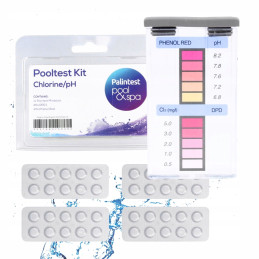
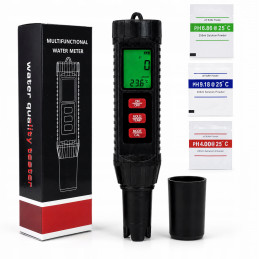
Test strips, a drop tester or a photometer are sufficient for basic measurement. You can find them in the pool water testers category. If a major chemical adjustment depends on the result, it is worth confirming it with a more accurate method. Strips stored in humidity or past their expiry date can give inaccurate readings.
How can you identify the cause by the appearance of the water?
The colour and timing of the cloudiness can tell you a lot. The table will help narrow down the cause, although a measurement should provide the final answer.
| Symptom | Most likely cause | What should be checked? |
|---|---|---|
| The water is greenish and the bottom or walls are slippery | algae and insufficient disinfection | pH, free chlorine and areas with poor circulation |
| The water turned white after adding pH Plus or filling the pool with hard water | precipitated calcium | pH, total alkalinity and calcium hardness |
| After chlorination, green water turned into a greyish-white haze | dead algae remaining in the water | filter condition, flow and filtration time |
| The water became cloudy after rain or heavy pool use | dust, pollen, cosmetics and rapid depletion of the disinfectant | pH, free chlorine, baskets and filter |
| pH and chlorine are correct, but the water remains cloudy | poor filtration, high CYA, hard water, fine suspended matter or an inaccurate reading | result from a second tester, CYA, TA, hardness and actual flow |
| A white haze appears mainly after the pump is switched on | microbubbles of air | water level, skimmer, pump lid gasket and suction lines |
| Dirt returns to the pool through the jets | damaged cartridge, an issue with the filter media or valve, or incorrect backwashing | the entire filtration system |
The glass test: air or suspended matter?
Take some water in a clean, transparent glass and place it against a light background. If the sample clears from the bottom upwards within a few minutes, microbubbles of air are most likely escaping from it. Sediment collecting on the bottom indicates suspended matter. When the water remains evenly milky for a long time, check pH, alkalinity and hardness – the cause may also be particles that the filter cannot retain.
Good to know: if, after 12–24 hours of efficient filtration, the water looks exactly the same, do not blindly add another product. Go back to the measurements and check the filter – the cause was probably identified incorrectly.
What causes cloudy or milky pool water?
The filter runs for too short a time or allows particles through
The pump is responsible for moving water, but the filter removes contaminants. A dirty cartridge, clumped or worn-out filter media, an incorrect valve setting, an air-locked pump or insufficient flow will leave dust and dead algae in the pool despite correctly selected chemicals.
Do not look only at the number of hours the pump runs. The actual flow rate is equally important, and it is usually lower than the value stated on the packaging. Long lines, a dirty filter and installation resistance all reduce it.
pH is too high
At high pH, chlorine loses effectiveness and calcium precipitates more easily as a white suspension. As a result, the water may look milky even if the disinfectant dose was correct. Lower pH gradually using an appropriate pool pH regulator and the dose stated on its label.
Disinfection cannot keep up with cleaning the water
Too little free chlorine, incorrect pH, a high contaminant load or excess CYA stabilizer can allow algae to grow. It usually starts innocently: with a slight haze and a slippery coating. A distinctly green colour appears later. If the water has already turned green, use the guide green pool water – causes and removal.
Calcium precipitates from hard water
White or milky water often appears after adding pH Plus, filling the pool with hard water, or during hot weather when pH rises. A combination of high pH, high alkalinity and high calcium hardness is particularly unfavourable. Another dose of chlorine or flocculant will not remove the cause – the water balance needs to be corrected.
Rain or a high number of swimmers has overloaded the water
Heavy rain carries dust, pollen and organic matter into the pool while also diluting the chemicals. During intensive pool use, cosmetics and other contaminants enter the water and rapidly consume chlorine. After a storm or pool party, remove debris, check the water level, pH and free chlorine, and extend filtration if necessary. Rain alone is not a reason to automatically carry out shock chlorination.
The pump is drawing in air
A large number of microbubbles looks almost identical to a milky suspension. Look for air beneath the transparent pump lid, an intermittent flow from the jets and cloudiness visible mainly while the circulation system is running. Check the water level, skimmer flap, lid gasket, connections and lines on the suction side.
Which parameters should be checked when the water is cloudy?
For slight, one-off cloudiness, start with pH and free chlorine. If the situation recurs or filtration does not improve it, check the other parameters as well.
| Parameter | Most commonly accepted range | What does the result indicate? |
|---|---|---|
| pH | 7,2–7,6 | high pH weakens chlorine action and promotes calcium precipitation; excessively low pH can cause corrosion and irritation |
| Free chlorine (FC) | CDC recommends at least 1 mg/l, and at least 2 mg/l when using CYA; the exact range depends on the system and product used | too little effective chlorine allows algae and microorganisms to grow |
| Combined chlorine (CC) | should remain as low as possible; assess it together with FC | high chloramine levels are often responsible for an irritating “chlorine smell” |
| Total alkalinity (TA) | usually 60–120 mg/l as CaCO3, depending on the installation and chemicals used | high TA makes it difficult to lower pH and promotes deposits, while excessively low TA causes rapid pH fluctuations |
| Calcium hardness (CH) | the range depends on the pool shell material and its manufacturer's recommendations | high CH combined with high pH and TA can cause milky water and scale deposits |
| Chlorine stabilizer (CYA) | often 20–50 mg/l in an outdoor pool; the correct level depends on the disinfection method | CYA protects chlorine from sunlight, but in excess it significantly slows its action |
The ranges in the table apply to typical private pools. Ultimately, follow the recommendations of the pool shell, equipment and chemical product manufacturers. A vinyl, plaster, saltwater pool or public facility may have different requirements.
Be careful when mixing chemicals: do not combine products in a bucket, skimmer or dispenser. Chlorine must not come into direct contact with acid, pH Minus, hydrogen peroxide or other chemicals. Add each product separately, according to its label and observing the stated interval. Protect your eyes and hands.
How do you clear pool water step by step?
Step 1. Calculate the pool volume
Without knowing the volume, it is easy to get the dose wrong. For a rectangular pool, multiply length, width and average depth. For a round pool, use the formula: 3,14 × radius2 × average depth. If all dimensions are given in metres, the result will be in m3.
Example: the label recommends 100 g of product per 10 m3, and the pool holds 15 m3. The required dose is therefore 150 g. However, do not use the dosage of a different product – a similar name does not mean the same concentration.
Step 2. Clean the pool shell and restore proper circulation
Remove larger debris, vacuum the bottom, brush the walls and empty the baskets. The pump should be primed, and there must be a steady flow from the jets. Backwash a sand filter when indicated by the pressure or the equipment instructions. Remove and wash the cartridge according to the manufacturer's recommendations.
Step 3. Adjust the pH
Most often, the correct range is 7,2–7,6. Adjust pH in small portions while the circulation system is running, then retest after the time stated on the label. One large dose can overshoot the target and make the water even cloudier.
Step 4. Match the action to the cause
If algae are visible or free chlorine is too low: after adjusting pH, carry out disinfection, selecting the dose according to the pool volume and product instructions. Brush areas with poor circulation and switch on filtration. See available pool chlorine. An algaecide may support cleaning, but it does not replace disinfection.
If the water turned white after pH Plus or is very hard: check pH, TA and CH. Lower pH gradually and filter the water. With persistently high hardness, a partial water replacement or a deposit-control product designed for the specific pool shell type may be needed.
If a grey suspension remains after algae have been destroyed: allow the filter to collect it and clean the filter when pressure rises or flow drops. If the finest particles return to the pool, select a clarifying product suitable for your installation.
If the water only becomes cloudy while the pump is running: look for where the system is drawing in air. No chemical product will fix a leaking gasket, water level that is too low or a blocked line.
Step 5. Filter and remove collected sediment
Water does not become clear immediately after disinfection. Dead algae must be captured by the filter or settle after flocculation, then be discharged while vacuuming. Monitor pressure and compare it with the value for a clean filter. Cloudiness alone does not mean that the filter media needs to be backwashed immediately.
Step 6. Test the water again
After completing the treatment, measure pH and free chlorine again. After shock chlorination, using a flocculant or another product, observe the swimming break stated by the manufacturer. You can return to the pool only when the entire bottom is visible and the measurements are within the correct range.
Cloudy or milky water after chlorination
A milky colour after chlorination does not necessarily mean chlorine has been overdosed. Most often:
- chlorine has destroyed the algae, but the filter has not yet removed their remains;
- high pH, TA and hardness have caused calcium precipitation;
- products were added at intervals that were too short, creating sediment;
- the filter is dirty, too small or operating with insufficient flow.
Measure pH and free chlorine. If the chlorine level is high, do not add another dose – keep the circulation running and wait for it to return to the correct range. In the event of a major overdose, you can use a chlorine deactivator. However, it must be measured very accurately, because an excess can completely neutralize the disinfectant.
Clarifier, coagulant or flocculant?
These terms are often used interchangeably, so do not choose a product based solely on the wording on the front of the package. Check the label to see whether the filter is supposed to capture fine particles after use, or whether the sediment should settle on the bottom.
| Product | How does it work? | What should be done after use? | When is it suitable? |
|---|---|---|---|
| Clarifier | combines fine particles into larger clusters | leave the filter running to capture the clusters | for light suspended matter and efficient filtration |
| Coagulant | enables very fine particles to combine | depending on the product, filter them out or carry out flocculation | when the filter lets through fine, evenly distributed cloudiness |
| Flocculant | forms larger flocs that can settle on the bottom | after switching off the circulation, slowly vacuum the sediment to the drain/WASTE | for a larger amount of suspended matter and an installation that allows sediment to be removed outside the filter |
A clarifying agent will not correct pH, replace disinfection or seal a pump. An overdose may even increase cloudiness or coat the cartridge and filter media. Measure the amount stated on the label precisely. See coagulants and pool water clarifying products.
Sand filter vs cartridge filter – what is the difference?
| Filter type | What should be done when the water is cloudy? | What should be avoided? |
|---|---|---|
| Sand or filter glass | compare pressure with the clean filter reading; backwash according to the instructions; after flocculation, vacuum sediment using the WASTE setting if the valve has this function | do not vacuum heavy sediment in FILTER mode, as some of it may return to the pool shell; do not backwash the filter simply because a set number of days has passed |
| Cartridge | remove and rinse the cartridge according to the instructions; check it more often when dealing with dead algae; replace a damaged or permanently clogged cartridge | do not use a flocculant that creates heavy sediment if the manufacturer does not permit it for cartridge filters; do not clean the material with a stiff brush |
| Small filter in an inflatable pool | check the full circulation time, cartridge condition and actual flow; it is useful to keep a clean spare cartridge on hand | do not assume that a dirty cartridge still delivers the performance stated on the package |
How long should cloudy water be filtered?
There is no single number of hours that is right for every pool. Start by calculating the time of one theoretical circulation cycle:
Time of one circulation cycle [h] = pool volume [m3] ÷ actual flow [m3/h]
With a volume of 30 m3 and an actual flow of 5 m3/h, one theoretical circulation cycle will take approximately 6 hours. This calculation is indicative: water does not mix perfectly, and flow decreases as the filter becomes dirty.
With greater cloudiness, the filter often runs continuously for the first day, provided the pump and filter instructions allow it. During this time, monitor flow and pressure. No improvement at all after 24 hours is a sign that you need to recheck the cause, test results and installation condition.
Action plan for the first 48 hours
| Time | What should be done? |
|---|---|
| 0–1 hour | remove debris, brush the pool shell, inspect the filter and measure pH and free chlorine |
| 1–6 hours | adjust pH and carry out the treatment indicated by the diagnosis; observe the intervals stated on the labels |
| 6–24 hours | filter and monitor flow and pressure; after flocculation, allow the sediment time to settle |
| 24–48 hours | vacuum sediment to the drain, top up the water and perform the measurements again |
| No improvement | confirm results with another tester; check TA, CH and CYA, as well as the valve, filter media and plumbing |
Can you swim in cloudy water?
Do not use the pool if the bottom is not clearly visible, you do not know the cause of the cloudiness, or the test results are outside the range. Poor visibility makes it difficult to notice a person underwater, and cloudiness may indicate ineffective disinfection.
After shock chlorination, using a flocculant or adjusting pH, wait for the period indicated by the product manufacturer. Return to swimming when the water is clear, the bottom is clearly visible, and pH and disinfectant levels are correct.
Home remedies for cloudy water – which ones can cause harm?
A product found in a kitchen cupboard may temporarily change the appearance of the water, but it rarely removes the true cause of cloudiness. Sometimes, it only creates another problem:
- Baking soda primarily raises alkalinity. With high pH, TA and hardness, it can further intensify milky cloudiness.
- Vinegar lowers pH, but its dose is difficult to control conveniently. It also adds organic compounds to the water that consume disinfectant.
- Vitamin C can temporarily remove discolouration caused by metals, but it reduces chlorine and does not remove the metals themselves from the water. We explain more in the article vitamin C for pools – why do we not recommend it?
- Hydrogen peroxide reacts with chlorine and may neutralize disinfection. Do not mix concentrated products.
- Gravel, tea and random aluminium salts may contain unknown additives and are difficult to dose correctly. This may result in pool contamination or filter damage.
The most sensible approach is measurement, identifying the cause and only then using a pool product with a known composition. You can find suitable products in the pool chemicals category.
Common mistakes when clearing water
Adding several products at once
Chlorine, a pH regulator and flocculant have different functions. Poured in at the same time, they may react with each other, form sediment or weaken one another's action.
Shock chlorination without testing
If the water has become cloudy due to calcium, air or an inefficient filter, another dose of chlorine will solve nothing. It will only extend the break from using the pool.
Overdosing clarifier or flocculant
A double dose does not mean an effect twice as fast. Excess product can create a sticky suspension, reduce clarity and coat the cartridge or filter media.
Vacuuming sediment through the filter
Heavy sediment formed after flocculation is usually vacuumed very slowly to the drain. In FILTER mode, some contaminants may return to the pool through the jets.
Backwashing the filter by the calendar
The main indicators that cleaning is needed are a pressure increase compared with a clean filter or a drop in flow. Specific limit values depend on the equipment, so check them in its instructions.

Not sure whether algae, hard water, a high stabilizer level or the filter is to blame? Prepare the pool volume, pH, free chlorine, TA, CH and CYA results, filter type, and the names of the products used. Contact us – based on this information, we will help determine the next steps.
How can you prevent cloudiness from returning?
- Measure pH and free chlorine regularly. During hot weather and frequent pool use, check them more often.
- Match filtration to the volume and actual flow. Empty baskets, clean the filter and monitor pressure.
- Brush areas with weaker circulation. Algae appear on surfaces before the water has time to turn visibly green.
- Monitor CYA if you use stabilized chlorine. The stabilizer accumulates in the water and does not disappear through normal evaporation.
- Limit the amount of contaminants entering the pool. Showering before swimming and covering the pool shell reduce the load on the filter and chemicals.
- Do not add products “just in case”. Every product should address a specific need.
If you are just putting together a water care kit, see the guide which pool chemicals should you buy to get started?
FAQ – cloudy and milky pool water
Why is the water cloudy despite correct pH and chlorine?
The cause may be filtration that is too short or ineffective, a dirty or damaged filter, dead algae, high hardness, excess CYA or fine dust. The test may also be inaccurate. Confirm the measurement using another method and check TA, CH, CYA and actual flow.
What should you do if the water turns milky after chlorination?
Check pH and free chlorine. If algae were previously present in the pool, the milky haze may be the remains after their destruction. If the problem appeared after a pH adjustment or concerns hard water, test TA and calcium hardness. Do not immediately assume another dose of chlorine is needed.
What product should be used for cloudy water?
It depends on the cause. Incorrect pH requires a regulator, algae require effective disinfection, and fine suspended matter requires a clarifier or flocculant matched to the filter. There is no single product that solves every case of cloudy water.
Clarifier or flocculant – which should you choose?
A clarifier works well for light suspended matter that the operating filter is meant to capture. Choose a flocculant when a larger amount of particles should settle on the bottom and can be vacuumed to the drain. For a cartridge filter, use only a product clearly intended for this type of installation.
How long does a flocculant take to work?
It depends on the product composition. Some work with the circulation running, while others require the pump to be stopped for several or a dozen hours so that sediment can settle. You will find the exact time on the label of the specific product.
Does a strong chlorine smell mean there is too much chlorine?
Not necessarily. Chloramines, compounds formed when chlorine reacts with contaminants, are often responsible for the irritating smell. Instead of judging the water by its smell, measure free and total chlorine.
How can you clear water without a pump?
Without circulation, it is difficult to distribute a product evenly and remove suspended matter. In a small pool, you can clean the bottom manually and replace some or all of the water, but filtration matched to the volume is required to maintain clarity consistently.
When does pool water need to be replaced?
Partial replacement is justified with very high CYA, excessive hardness, a significant chemical overdose or contamination that cannot be removed. Before draining an in-ground pool, check the manufacturer's recommendations – groundwater pressure can damage the pool shell.
Sources
- CDC – Home Pool and Hot Tub Water Treatment and Testing – measuring pH and disinfectant level.
- CDC – Pool Chemical Safety – safe dosing and chemical handling principles.
- Fluidra / AstralPool – Pool Water Treatment and Maintenance – water balance and filtration practices.
- Pentair – Triton Sand Filter Installation and User's Guide – filter operation and pressure-dependent backwashing.
Author: Maciej Waliduda – has been selecting filtration systems and water care solutions for years.
Last updated: 2026-07-21.