

Free delivery from 200 zł

14 days to return your order

Fast delivery in 1-2 days


Technical support 24/7!

Over 27 years of experience
Testers, water meters
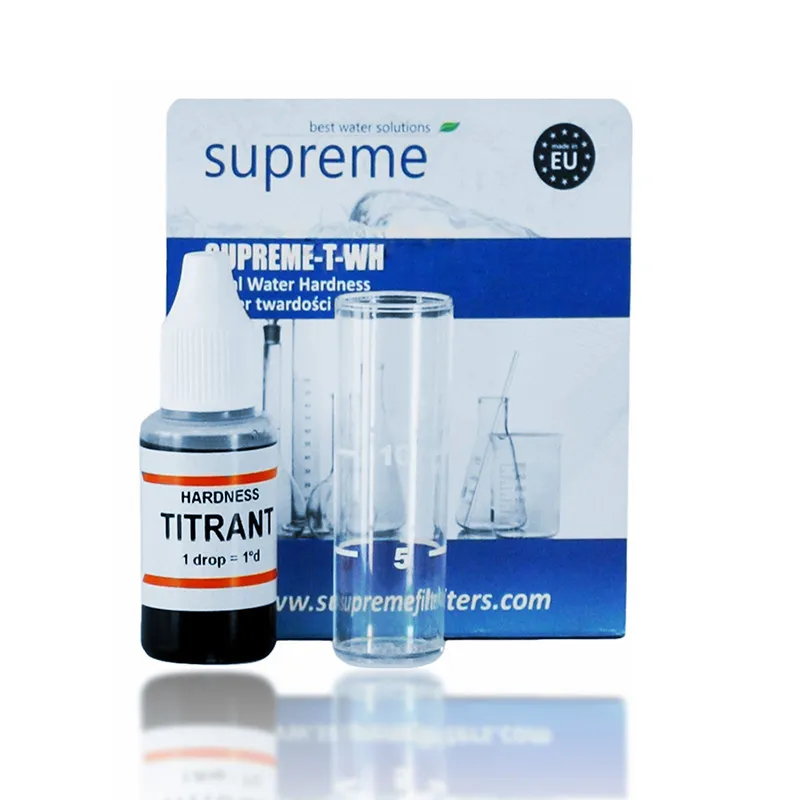
Supreme drop water hardness tester
Rating
Supreme TITRANT is a professional drop tester for determining the total hardness of water in the system. It allows for multiple measure Read moreShow less
Supreme TITRANT is a professional drop tester for determining the total hardness of water in the system. It allows for multiple measurements, and the result is provided in dH (German degrees) , commonly used in Poland. It helps quickly assess whether the water qualifies for softening to protect installations, fittings, and household appliances from limescale buildup.
Specifications

KT-SUPREME
9930 Items
- Measured parameter
- Hardness
- Product type
- Water tester / meter
- Test method
- Drop titration
Description
Supreme TITRANT – drop water hardness tester is a practical and professional tool for quickly checking the overall hardness of water in an installation. It makes it easier to assess whether the water needs softening to better protect pipes, fixtures, the washing machine, dishwasher, and other elements of the system. This is a useful solution wherever informed water treatment, selection of a water filter, or compatibility with equipment such as a water softener or another water filtration system matters. The reading is given in German degrees dH, commonly used in Poland.

What is the Supreme TITRANT tester used for?
Supreme TITRANT is used to determine the overall hardness of water in the water installation in use. Thanks to its drop-based formula, it allows convenient control of water parameters in a house, apartment, commercial premises, or anywhere water quality affects the durability of the installation and devices.
This is a particularly useful solution before selecting devices to improve water quality and during operation of the installation, when you want to check whether the hardness level falls within the desired range.
Main benefits
- allows quick determination of overall water hardness,
- provides the result in dH units (German degrees), commonly used in Poland,
- allows multiple measurements,
- helps assess whether the water should be softened,
- supports protection of the water installation, fixtures, and household appliances against limescale buildup,
- helps decide on solutions such as a water softener or another water quality improvement system.
Why does measuring water hardness matter?
Excessively hard water promotes the formation of limescale, also called boiler scale. This deposit can build up in water installation components, fixtures, and household appliances connected to water.
If the water hardness is higher than 10–12 dH, the water already qualifies for softening in order to protect the water installation and the fixtures and household appliances connected to it, such as a washing machine or dishwasher. Water softening helps limit limescale buildup and therefore supports longer and more trouble-free operation of devices.
It is worth measuring water hardness before purchasing or adjusting water treatment devices. The test result helps better assess whether a water softener is needed in a given installation and which level of protection against limescale will be most appropriate.
Performance and number of measurements
The Supreme TITRANT tester allows repeated measurements. The number of possible tests depends on the hardness of the tested water.
- depending on water hardness, it may be possible to perform about 10 measurements or about 30 measurements,
- typically about 27 measurements at 15 dH can be obtained.
This makes the tester suitable not only for one-time checking, but also for periodic monitoring of water parameters in the installation.
General water hardness scale
Interpreting the result is simple and allows you to quickly assess what kind of water you are dealing with. The general water hardness scale is as follows:
- 0–4 dH - very soft water
- 5–8 dH - soft water
- 9–12 dH - moderately hard water
- 13–18 dH - hard water
- 19 dH and above - very hard water
Practical use
The drop water hardness tester can be used as convenient support when assessing water quality in domestic and utility installations. It is helpful when planning limescale protection and when deciding on devices that improve water parameters.
Measuring hardness can also be useful when a water filter, softener, or more advanced treatment system is already operating in the installation. It allows you to monitor installation operating conditions and better adapt maintenance actions to the real water parameters.
Technical specifications
| Product type | Drop tester for overall water hardness |
|---|---|
| Trade name | Supreme TITRANT |
| Application | Determination of overall water hardness in a water installation |
| Result unit | dH (German degrees) |
| Number of measurements | Multiple measurements; approximately 10 to approximately 30 tests, typically about 27 measurements at 15 dH |
| Threshold indicating the need for softening | Above 10–12 dH |
FAQ
What is Supreme TITRANT used for?
The tester is used to determine the overall hardness of water in a water installation. It helps quickly check whether the water is soft, moderately hard, hard, or very hard, and whether softening should be considered.
In what units is the result given?
The result is given in dH units, i.e. German degrees. This is a scale commonly used in Poland to determine water hardness.
How many measurements can be made with one tester?
The number of measurements depends on the hardness of the tested water. It may be about 10 measurements or about 30 measurements, and typically about 27 measurements are obtained at a hardness of 15 dH.
From what hardness level is water softening worth considering?
If water hardness exceeds 10–12 dH, the water already qualifies for softening to protect the installation, fixtures, and household appliances against limescale buildup.
How should a result of 0–4 dH be interpreted?
The 0–4 dH range means very soft water. It is the lowest level in the presented general water hardness scale.
How should a result of 13–18 dH or 19 dH and above be interpreted?
A result of 13–18 dH means hard water, while 19 dH and above means very hard water. Such values indicate a greater risk of limescale buildup in the installation and devices.
Does the tester help choose water treatment devices?
Yes, measuring water hardness is very helpful when deciding on solutions such as a water softener, a water filter, or another filtration and treatment system.
Why is hard water a problem for installations and household appliances?
Hard water promotes the formation of limescale, also known as boiler scale. The deposit can build up in the water installation, fixtures, washing machine, and dishwasher, making proper operation more difficult and increasing the risk of service issues.
Tani
Godny uwagi tester
Super
Działa dobrze, jestem zadowolony
Super tester
Tester wielokrotnego użytku działa bez zarzutów.