
MOJAWODA
How to choose a water filter in 5 steps
From your first measurement to an informed purchase. Choose the right test, understand your results and use the MojaWoda filter advisor.
Identify your water source and goal
For mains water, begin with your supplier’s latest report. Note what you want to improve: taste, smell or limescale. Measure hardness at your own tap before choosing a softener.
For well water, arrange chemical and microbiological testing before buying a treatment system. Clear, odourless water is not proof of safety. Tell the laboratory about your source, intended use and existing filters.
Write down the number of users, installation location, current equipment, flow rate and pressure.
16 Polish regions · 16 laboratories
Find a laboratory in 2 steps
Choose a Polish region, then contact the laboratory. Before taking a sample, agree on the tests, price, containers and delivery time.
Dolnośląskie
Wrocław
Ekolabos — Laboratorium Badania Wody
ul. Duńska 9, 54-427 Wrocław
Confirm the tests and sampling arrangements before your visit.
Kujawsko-pomorskie
Bydgoszcz
WSSE w Bydgoszczy — Dział Laboratoryjny
ul. Kujawska 4, 85-031 Bydgoszcz
[email protected]General station contact. Ask for the water-testing laboratory.
Lubelskie
Lublin
WSSE w Lublinie — badania wody
ul. Pielęgniarek 6, 20-708 Lublin
[email protected]Arrange a date and obtain the laboratory’s containers and sampling instructions first.
Lubuskie
Gorzów Wlkp.
WSSE w Gorzowie Wielkopolskim — Oddział Badań Środowiskowych
ul. Kazimierza Jagiellończyka 8B, 66-400 Gorzów Wielkopolski
[email protected]Confirm the tests and sampling arrangements before your visit.
Łódzkie
Łódź
ZWiK w Łodzi — Laboratorium Badania Wody
ul. Graniczna 54, 93-428 Łódź
[email protected]Sign the order at the laboratory, collect the containers and agree on sample delivery.
Małopolskie
Kraków
WSSE w Krakowie — Oddział Laboratoryjny Badania Wody
ul. Prądnicka 76, 31-202 Kraków
[email protected]Confirm the tests and sampling arrangements before your visit.
Mazowieckie
Warszawa
WSSE w Warszawie — Oddział Laboratoryjny Higieny Komunalnej
ul. Żelazna 79, 00-875 Warszawa
[email protected]Sample reception: extension 702. The email is for water tests and sampling.
Opolskie
Opole
WSSE w Opolu — Laboratorium Badań Wody
ul. Mickiewicza 1, 45-367 Opole
[email protected]Confirm the tests and sampling arrangements before your visit.
Podkarpackie
Rzeszów
WSSE w Rzeszowie — Dział Laboratoryjny
ul. Wierzbowa 16, 35-959 Rzeszów
[email protected]General station contact. Ask for the water-testing laboratory.
Podlaskie
Białystok
Wodociągi Białostockie — Laboratorium Badania Wody
ul. Wysockiego 160, 15-126 Białystok
Arrange a date and obtain the laboratory’s containers and sampling instructions first.
Pomorskie
Gdańsk
WSSE w Gdańsku — Laboratorium Badań Wody
ul. Dębinki 4, 80-211 Gdańsk
[email protected]Arrange sampling by laboratory staff. WSSE Gdańsk does not accept self-collected water samples. General station contact.
Śląskie
Katowice
GPW — Wydział Badania Wody
ul. Żeliwna 38, 40-599 Katowice
Arrange a date and obtain the laboratory’s containers and sampling instructions first.
Świętokrzyskie
Nowiny k. Kielc
Wodociągi Kieleckie — Centralne Laboratorium Wodno-Ściekowe
ul. Przemysłowa 93, Nowiny koło Kielc
Confirm the tests and sampling arrangements before your visit.
Warmińsko-mazurskie
Olsztyn
PWiK Olsztyn — Laboratorium Działu Jakości Wody i Ścieków
ul. Oficerska 16a, Olsztyn
[email protected]Arrange a date and obtain the laboratory’s containers and sampling instructions first.
Wielkopolskie
Poznań
WSSE w Poznaniu — Laboratorium Badania Wody
ul. Noskowskiego 21, 61-705 Poznań
[email protected]Arrange a date and obtain the laboratory’s containers and sampling instructions first.
Zachodniopomorskie
Szczecin
ZWiK Szczecin — Laboratorium Centralne
ul. Szczawiowa 9–14, Szczecin; wejście od ul. Boryny 63
[email protected]Arrange a date and obtain the laboratory’s containers and sampling instructions first.
Selected water-testing facilities; this is not a complete register. Details checked on institutional websites on 7 November 2026. Map points show approximate town locations. Natural Earth.
Choose a test and measure your water
Use a WODARO drop test to measure total hardness before choosing a softener and to check its performance afterwards. Follow the sample volume, colour-change endpoint and unit conversion specified in the kit instructions.
Use the WODARO 7-in-1 meter for pH, EC and TDS, with additional ORP, salinity, relative density and temperature measurements. Prepare and calibrate it as instructed, rinse the probe and wait for a stable reading. TDS does not measure hardness or establish water safety.
Ask a laboratory about iron, manganese, ammonium, nitrate, nitrite, pH, hardness, turbidity and microbiological testing, including E. coli and intestinal enterococci. Agree on the sampling point, containers and transport before collecting water. For selecting treatment, a sample before the existing filter is usually needed.
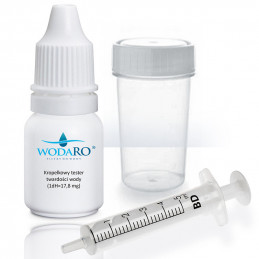
WODARO drop test
View tester →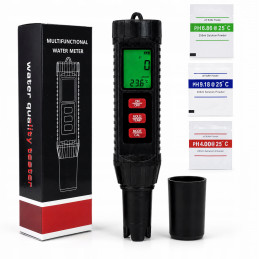
WODARO 7-in-1 meter
View tester →Read your results and check the units
Compare the same parameter in the same unit. For example, 0.30 mg/l of iron equals 300 µg/l. For hardness, 20 °dH is approximately 356 mg CaCO₃/l; use the converter when necessary.
The infographic uses reference values for Poland. Green applies to one parameter only; it does not confirm overall water safety. Bars are schematic and do not indicate risk magnitude.
If bacteria are detected or nitrate/nitrite limits are exceeded, use a safe drinking-water source and contact the relevant public health authority. Boiling does not remove nitrate.
The infographic shows 4 basic parameters. The complete table of 9 parameters and filter guidance is available in the Polish guide.
Full table of 9 parameters in Polish →
Compare your result with the range
4 basic water parameters
Bars show schematic ranges. A single result does not establish overall water safety.
Enter your results in the filter advisor
Prepare your report, including values, units, date and sampling point. Open the advisor in results mode, choose your water source and answer the questions about intended use.
Enter available measurements in the units shown beside the fields. Do not replace missing measurements with zero. Check the recommended treatment direction and open the suggested product pages.
If results are incomplete or several parameters need treatment, complete the tests or ask an advisor to confirm the configuration.
Check your installation and buy your filter
Before purchasing, check the manufacturer’s permitted input-water parameters, capacity, flow rate, pressure, connections and space for installation and servicing. Some systems need drainage or power.
Compare running costs, cartridge availability, replacement intervals and warranty conditions. Confirm complex whole-house installations with an advisor.
After installation, check the result: measure hardness with a tester and repeat laboratory tests where needed. Maintain the device according to its instructions.
Reference information for Poland. Updated 6 November 2026. Dz.U. 2026 poz. 748 · Laboratory sampling guidance · CDC