

Free delivery from 200 zł

14 days to return your order

Fast delivery in 1-2 days


Technical support 24/7!

Over 27 years of experience
Testers, water meters
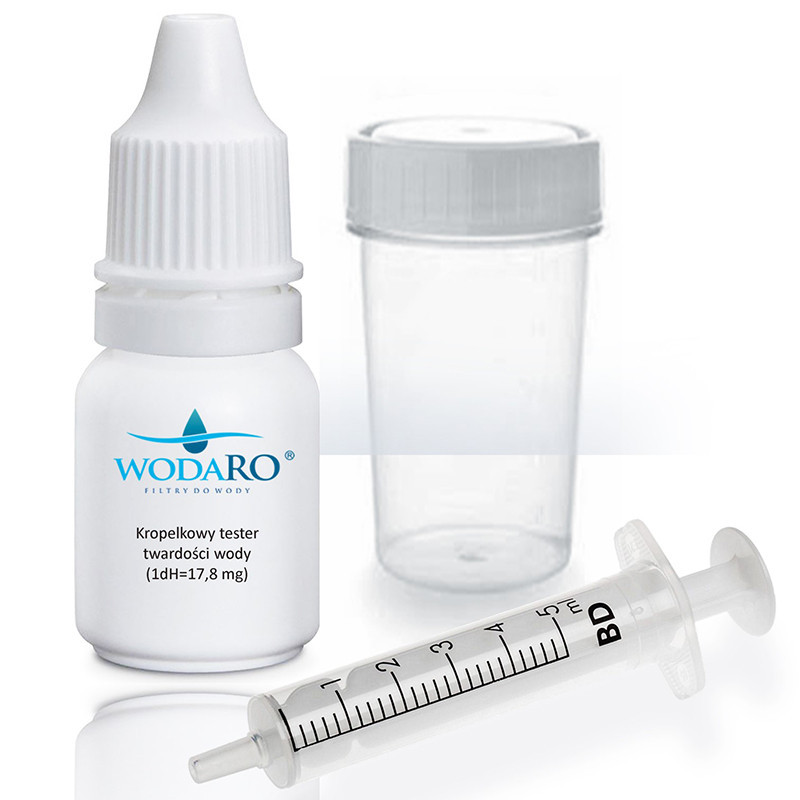
Droplet water hardness tester
Rating
Drop test for general water hardness (dH). It facilitates checking the hardness of water in the system and adjusting the settings of th Read moreShow less
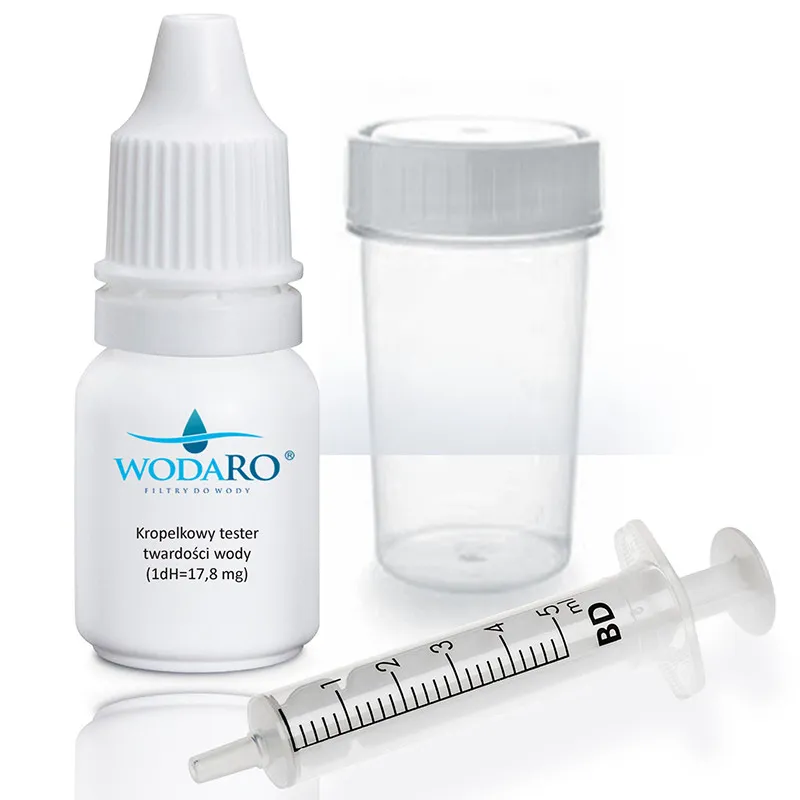
Drop test for general water hardness (dH). It facilitates checking the hardness of water in the system and adjusting the settings of the water softener, as well as assessing the risk of limescale buildup in the washing machine, dishwasher, and fixtures. The measurement is performed by adding drops of reagent to the sample in the included container until the color changes from red to blue.
Specifications

KT-WODARO
9894 Items
- Measured parameter
- Hardness
- Product type
- Water tester / meter
- Test method
- Drop titration
Description
Droplet water hardness tester is a practical tool for quickly checking the general hardness of water in a home installation. It helps assess the risk of limescale buildup, adjust the settings of devices such as a water softener, and better plan water treatment at home. It is a useful solution wherever a water filter, household appliance system, or an advanced water filtration system is in use, and where monitoring water parameters matters for installation durability and user comfort.
The measurement is carried out using the drop method: the reagent is added to a water sample in the included vessel until the color changes from red to blue. The number of drops used allows the hardness to be determined in dH units, i.e. German degrees commonly used in Poland.
What is a droplet water hardness tester used for?
This is a universal tester designed to determine the general hardness of water in a water installation in use. It is especially helpful when installing and commissioning devices for which the level of water hardness has direct operational significance.
- it makes it easier to assess water hardness in a home installation,
- it helps with selecting and setting up a water softener,
- it allows you to estimate the risk of scale buildup in a washing machine, dishwasher, and fixtures,
- it supports the protection of the water installation and connected household appliances.
Regular water hardness testing is useful both in standard home installations and where a more advanced water treatment system is used. The test result can be a valuable guideline before configuring devices responsible for filtration, fixture protection, and reducing deposits.
How does the drop method work?
The tester uses a single-component reagent in the form of drops. The drops act both as an indicator and as a water hardness counter. The measurement is performed directly in the vessel included in the set.
The test consists of gradually adding the reagent to the water sample until the tested sample changes color from red to blue. The number of drops used corresponds to the water hardness result obtained on the dH scale.
- the measurement is simple and easy to read,
- it does not require complicated handling,
- the result is obtained directly during the test,
- the unit of measurement is dH, i.e. German degrees.
If the result indicates hardness above 10-12 dH, the water qualifies for softening in order to protect the water installation, fixtures, and household appliances such as the washing machine and dishwasher. Water softening helps reduce the buildup of calcium scale, i.e. boiler scale.
Main practical benefits
- allows repeated measurements,
- helps make informed decisions regarding the protection of installations and devices,
- makes it easier to determine whether a water softener is needed,
- lets you monitor water used at home and in household appliances,
- works well as practical support when planning a water treatment system.
Depending on the hardness of the tested water, the tester allows for about 10 to 30 measurements. Typically, about 20 measurements can be obtained at 17 dH hardness.
Interpreting the measurement result
The general water hardness scale is as follows:
- 0-4 dH - very soft water
- 5-8 dH - soft water
- 9-12 dH - moderately hard water
- 13-18 dH - hard water
- 19 dH and above - very hard water
This classification makes it easier to assess whether the water in the installation may encourage deposits and whether additional protective measures are worth implementing. This is especially important in installations that use a softener, a water filter, a reverse osmosis filter, a reverse osmosis system, or other solutions supporting water treatment.
Use at home and in the installation
The droplet water hardness tester is suitable wherever water quality needs to be checked quickly for limescale risk. It is indispensable when installing and commissioning a water softener, but it is also useful for ongoing monitoring of water parameters used at home.
- water installations in houses and apartments,
- checking the operation of a water softener,
- testing water for a washing machine and dishwasher,
- assessing the impact of hard water on fixtures,
- supporting the planning of protection for devices and installation components.
Technical specifications
| Product type | Droplet tester for general water hardness |
|---|---|
| Intended use | Measurement of water hardness in a water installation |
| Measurement method | Adding drops of reagent to the water sample until the color changes from red to blue |
| Measurement unit | dH (German degrees) |
| Reagent type | Single-component preparation |
| Number of possible measurements | About 10-30 depending on water hardness; typically about 20 measurements at 17 dH |
| Measuring vessel | Included in the set |
| Threshold indicating the need for softening | Above 10-12 dH |
Questions
How does the droplet water hardness tester work?
Drops of reagent are added to a water sample in the included vessel until the sample changes color from red to blue. The number of drops used indicates the water hardness in dH units.
In what units is the result given?
The tester determines water hardness in dH, i.e. German degrees. This is a scale commonly used in Poland when assessing water hardness and setting up softeners.
How many measurements can be made with one tester?
The number of possible measurements depends on the hardness of the tested water. Usually, about 10 to 30 measurements can be made, and typically about 20 measurements at 17 dH hardness.
When is it worth considering water softening?
If the measurement result exceeds 10-12 dH, the water qualifies for softening to protect the water installation, fixtures, and household appliances from scale buildup.
What is water hardness testing useful for at home?
The measurement helps assess the risk of scale buildup in a washing machine, dishwasher, fixtures, and installation pipes. It also makes it easier to select water softener settings and better plan protection for the entire water system.
How should the test result be interpreted?
The general scale is as follows: 0-4 dH is very soft water, 5-8 dH soft water, 9-12 dH moderately hard water, 13-18 dH hard water, and 19 dH and above very hard water. The higher the result, the greater the risk of scale formation.
Is the tester suitable for checking water before installing a softener?
Yes, this is one of its main uses. The tester is very helpful when installing and commissioning a water softener, because it allows you to determine the current hardness in the installation.
Does such a tester make sense if the house already has a water filter or reverse osmosis system?
Yes, because monitoring water parameters is still important for proper system operation. The tester can be useful in a home where a water filter, osmotic filter, reverse osmosis system, or another water filtration system is in operation, especially if you want to assess the risk of deposits and the need for additional softening.
dostawa w 24h
Szybka realizacja zamówienia.
super
tester wielokrotnego użytku, działa super
spełnia swoje zadanie
szybka dostawa, produkt ok
GIT
spoko, szybka dostawa
Działa prawidłowo
za małe pieniądze, rzecz naprawdę przydatna, polecam
Działa
Robi co trzeba
Tester twardości
Tester działa prawidłowo jestem zadowolona z zakupu.