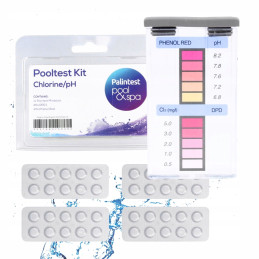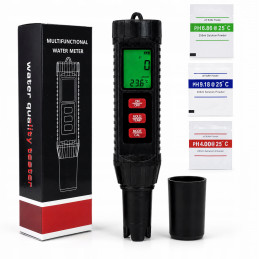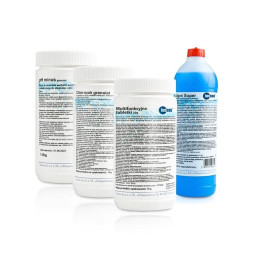
If you are wondering what pool chemicals you need to get started, begin with a simple set: a water tester, a pH adjuster, a disinfectant, an algaecide, and efficient filtration. Only later should you choose emergency products such as a coagulant, clarifier, or shock chlorine. The biggest mistake in pool maintenance is adding more products without testing the water. This can easily make the situation worse instead of fixing it.
In this guide, you will find a ready-made starter shopping list, a simple order for using chemicals, approximate dosage per m³ of water, basic parameter ranges, and practical instructions on what to do with green, cloudy, or unpleasant-smelling water.
The shortest answer: to get started, buy a pH/chlorine tester, pH minus, pH plus, chlorine or active oxygen, an algaecide, and a tablet dispenser. It is worth keeping a coagulant or clarifier for emergencies, but it does not replace disinfection or filter operation.
What you will learn from this article
- what pool chemicals you need to get started,
- which set to buy in a minimum, convenient, and emergency version,
- which pH and chlorine levels are considered correct,
- how to calculate pool volume in m³ and convert the product dosage,
- in what order to use pool chemicals,
- the difference between chlorine, active oxygen, algaecide, clarifier, and coagulant,
- what to do when pool water turns green, cloudy, or smells strongly of chlorine.
Table of contents
- What pool chemicals do you need to get started?
- Ready-made pool chemical sets by situation
- How to calculate pool volume?
- Correct pool water parameters
- Approximate pool chemical dosage
- In what order should you use pool chemicals?
- Pool water tester
- Adjusting pH in a pool
- Pool chlorine
- Active oxygen for pools
- Pool algaecides
- Clarifier, coagulant, and flocculant
- Pool water filtration
- Pool water problems
- Pool maintenance schedule
- Safe use of pool chemicals
- FAQ
What pool chemicals do you need to get started?
To get started, you do not need a dozen products. You need products that allow you to do three basic things: test the water, set its pH, and maintain disinfection. Only later should you choose additions for specific issues, such as algae, cloudy water, or deposits on the walls.
Basic pool chemicals should be selected according to pool size, water temperature, filtration type, frequency of swimming, and whether the pool is in full sun. A small garden pool used by children requires a different approach than a larger frame pool with a sand filter pump.
| Item | What it is used for | Should you buy it to get started? |
|---|---|---|
| Water tester | Shows the pH and disinfection level. Without a tester, you do not know which product is really needed. | Yes, essential. |
| pH minus | Lowers excessively high pH. At high pH, disinfection works less effectively and the water is more likely to cause problems. | Yes, it is usually needed more often than pH plus. |
| pH plus | Raises excessively low pH. Use it only when the measurement shows it is needed. | Yes, it is worth having in the set. |
| Chlorine or active oxygen | Responsible for water disinfection. Choose one method and follow its rules. | Yes, without disinfection, water quickly loses quality. |
| Algaecide | Limits algae growth, especially in garden pools exposed to sunlight. | Yes, as prevention and support for green water. |
| Tablet dispenser or floater | Makes chlorine tablets dissolve safely. Protects the pool bottom from contact with the tablet. | Yes, if you use tablets. |
| Coagulant, flocculant, or clarifier | Helps with cloudy water and fine suspended particles that the filter cannot catch on its own. | Worth keeping for emergencies. |
| Pool cleaning product | Helps remove dirt from the waterline, walls, bottom, and pool components. | Useful for regular maintenance. |
Ready-made pool chemical sets by situation
The easiest way to choose pool chemicals is according to the situation. One set is suitable for a person filling their pool for the first time, another for someone who wants emergency products for green water, and another for a user who does not want traditional chlorine care.
| Situation | What to buy | Why |
|---|---|---|
| First season and first garden pool | Water tester, pH minus and pH plus, pool chlorine or active oxygen, algaecide, tablet floater. | This set lets you monitor the water, set the pH, and maintain disinfection. |
| You only want the absolute minimum | Tester, pH minus, a selected disinfectant, and efficient filtration. | This is the technical minimum. It is still worth adding algaecide if the pool is outdoors. |
| The pool is in the sun and children use it | Tester, pH minus/pH plus, chlorine or active oxygen, algaecide, spare filter cartridges, leaf net. | Sun, high temperatures, and intensive swimming quickly worsen water parameters. |
| You want an emergency set | Shock chlorine or a fast disinfectant, algaecide, clarifier or coagulant, spare testers. | This set is useful after a storm, heatwaves, intensive swimming, or sudden cloudiness. |
| You do not want traditional chlorine | Active oxygen, a suitable active oxygen tester, pH adjuster, and a maintenance-supporting product compatible with the selected system. | Active oxygen is an alternative to chlorine, but it also requires regular measurements. |
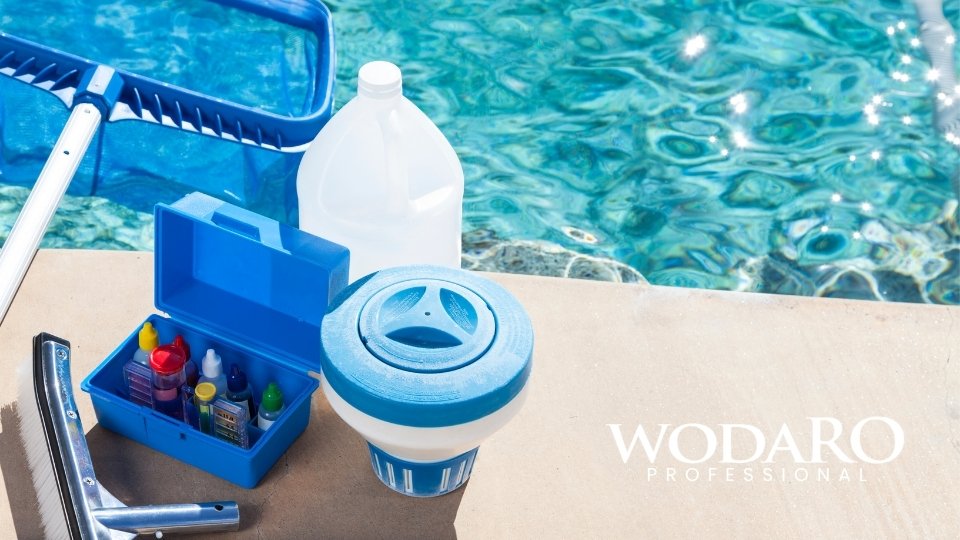
If you are putting together chemicals for your first season, start with these categories: pool water testers, pH adjusters, pool chlorine, active oxygen, and algaecides.
How to calculate pool volume?
Pool chemical dosage is most often given per 1 m³ of water. Therefore, before using a product, you need to know how much water is in the pool. 1 m³ equals 1000 litres.
| Pool type | Formula | Example |
|---|---|---|
| Rectangular pool | length x width x average depth | 4 m x 2 m x 0,8 m = 6,4 m³ |
| Round pool | 3,14 x radius x radius x average depth | A 366 cm pool has a radius of 1,83 m. 3,14 x 1,83 x 1,83 x 0,75 m = approximately 7,9 m³ |
| Oval pool | length x width x average depth x 0,8 | 5 m x 3 m x 1 m x 0,8 = approximately 12 m³ |
If the pool manufacturer gives capacity in litres, convert it to m³ by dividing by 1000. A pool with 8000 litres has approximately 8 m³ of water. This matters because the dosage for a 4 m³ pool will be entirely different from that for a 12 m³ pool.
Correct pool water parameters
Water parameters are the starting point for every decision. If pH is incorrect and the disinfection level is too low, adding random products will not solve the problem. The water may still turn green, cloudy, or unpleasant for swimming.
| Parameter | Practical monitoring range | What does a problem mean? |
|---|---|---|
| pH | The usual target is approximately 7,0-7,4. A broad monitoring range for pools is usually around 7,0-7,8. | Excessively high or low pH reduces maintenance effectiveness and swimming comfort. |
| Free chlorine | For chlorine maintenance, assume a minimum of approximately 1 mg/l. For stabilized chlorine and cyanuric acid, a minimum of approximately 2 mg/l. | Too low a level means weak disinfection and a greater risk of algae and cloudy water. |
| Total chlorine | It is worth monitoring if your tester allows it. | A large difference between total and free chlorine indicates combined chlorine, i.e. chloramines. |
| Active oxygen | The range depends on the specific system and tester. | Active oxygen should not be assessed using a tester intended only for chlorine. |
| Chlorine stabilizer / CYA | Check periodically if you use stabilized tablets or granules. | Too high a stabilizer level may weaken the practical effect of chlorine. |
In practice, always compare the result with the tester instructions and the product label. Different products may have different recommendations, so one table should not be treated as a replacement for the manufacturer’s instructions.
Important: 1 ppm in water is approximately equal to 1 mg/l. If the tester shows results in ppm and the product label uses mg/l, you can treat these units as equivalent for basic pool maintenance.
Approximate pool chemical dosage
Pool chemical dosage depends on the product concentration, pool volume, current water parameters, and purpose of use. A product for regular maintenance is dosed differently from one used as an emergency treatment for green or cloudy water.
The table below is approximate. It is intended to help plan your purchase and understand the dosage scale, but it does not replace the label of a specific product.
| Product | Approximate amount per 1 m³ of water | When to use it? | Most important note |
|---|---|---|---|
| pH minus | Often approximately 10 g per 1 m³ to lower pH by approximately 0,1. | When the measurement shows pH is too high. | Adjust gradually. Test again after the water has mixed. |
| pH plus | Often approximately 10 g per 1 m³ to raise pH by approximately 0,1. | When the measurement shows pH is too low. | Do not raise pH with one large dose, especially in a small pool. |
| Fast chlorine or shock chlorine | Often a few to a dozen or so grams per 1 m³, depending on the product and mode of use. | When starting the pool, after a storm, after intensive swimming, or when water problems occur. | After stronger chlorination, return to swimming only after the time indicated on the label and after testing the water. |
| Slow-dissolving chlorine tablets | Depends on tablet weight and pool capacity. 20 g tablets are usually used in smaller pools, and 200 g tablets in larger ones. | For ongoing maintenance of disinfection. | Do not throw tablets loosely onto the bottom. Use a floater, skimmer, or dispenser unless the manufacturer recommends otherwise. |
| Active oxygen | The dosage depends on the system, product form, and tester. | As an alternative to chlorine. | Active oxygen also requires regular monitoring. It is not a maintenance-free method. |
| Algaecide | Often approximately 10-20 ml per 1 m³ for the first use, followed by smaller maintenance doses. | Preventively and when there is a risk of algae growth. | Algaecide alone is not enough for green water. Disinfection, filtration, and cleaning are required. |
| Clarifier or coagulant | Often approximately 10 ml per 1 m³, depending on the product and degree of cloudiness. | For cloudy water and fine suspended particles. | It does not disinfect the water. It helps the filter collect fine dirt. |
How do you calculate the dosage for your pool?
Multiply the pool volume by the dosage per 1 m³. If the pool holds 8 m³ and the label states 10 g of product per 1 m³, you need approximately 80 g. If the pool holds 12 m³, at the same dosage you need approximately 120 g.
When adjusting pH or carrying out stronger disinfection, it is not worth adding the whole large dose without checking. It is safer to act in stages: add the product according to the instructions, turn on filtration, wait for the time stated by the manufacturer, and test again.
In what order should you use pool chemicals?
The order matters. If you add products in a random order, you may weaken their effect, make filtration more difficult, or create a dangerous chemical reaction. Do not mix different products directly together.
- Remove leaves, sand, and visible dirt from the pool.
- Check that the pump and filter are working correctly.
- Test the pH and disinfectant level.
- Adjust the pH if the result requires it.
- Turn on filtration so the water mixes thoroughly after pH adjustment.
- Use chlorine or active oxygen according to the product label.
- If there is a risk of algae, use an algaecide according to the instructions.
- For cloudy water, consider a clarifier, coagulant, or flocculant, but only after checking pH, disinfection, and the filter.
- Test again after the time stated by the manufacturer.
Do not add several products to one bucket at the same time and do not mix pool chemicals “dry”. Use each product separately, according to its label and with filtration running if the instructions require it.
Pool water tester - why is it more important than another product?
A water tester is the basic tool for pool maintenance. Without testing, you do not know whether the problem is pH, a low disinfection level, a dirty filter, algae, or fine suspended particles. In practice, many problems begin with acting “by eye”. A user sees cloudy water and adds chlorine. Then they add algaecide, later coagulant, and the water still looks bad because the cause was a dirty filter or incorrect pH.
For basic monitoring, a pool water tester that measures pH and disinfectant level is usually sufficient. Strip testers are quick and convenient. Drop testers require greater precision, but often make results easier to read. The most important thing is to test regularly and according to the instructions.
How often should you test pool water?
| Situation | How often to test? |
|---|---|
| Normal use during the season | Every 2-3 days. |
| Heatwaves, full sun, frequent swimming | Daily or before intensive pool use. |
| After a storm or heavy rain | Immediately after the water has stabilized and dirt has been removed. |
| After shock chlorination or a major pH adjustment | After the time stated on the product label. |
| When water turns green, milky, or slippery | Immediately, before adding more products. |
Adjusting pH in a pool
pH determines how effectively disinfection works and how comfortable swimming is. If pH is too high, chlorine may work less effectively and the water can turn cloudy more easily. If pH is too low, the water may irritate skin and eyes and adversely affect pool components.
Pool pH adjusters are used for correction. pH minus lowers pH, while pH plus raises it. They are not used preventively. Use them when the measurement shows a specific need for adjustment.
Most common mistakes when adjusting pH
- Adding chlorine without first testing pH.
- Adjusting pH with a single excessively large dose.
- Not testing again after the water has mixed.
- Using pH minus and pH plus “just in case”.
- Assuming that clear water always has the correct pH.
Pool chlorine - when is it the best choice?
Pool chlorine is the most popular method of water disinfection. It is practical, readily available, and works well in typical garden pools when users regularly monitor pH and free chlorine levels.
Chlorine is available in tablets, granules, and fast-disinfection products. They differ in speed of action, purpose, and dosing method. They should not be treated as interchangeable without checking the manufacturer’s instructions.
| Chlorine form | When is it useful? | What should you watch out for? |
|---|---|---|
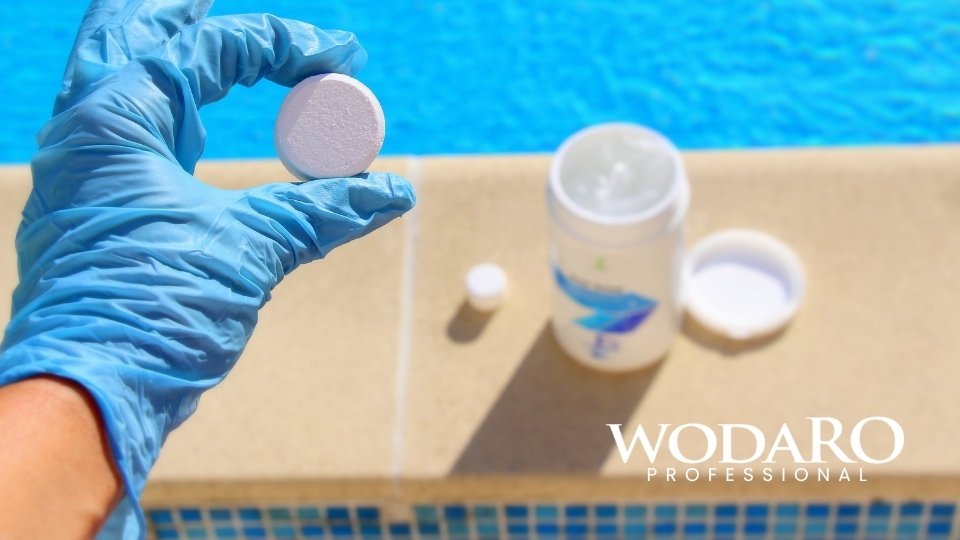
| Chlorine tablets | For regular maintenance of water disinfection. | Do not throw them directly onto the pool bottom unless the manufacturer permits it. |
| Chlorine granules | For faster adjustment of the disinfection level. | Use according to the label. Do not mix with other products. |
| Shock chlorine | When starting the pool, after intensive swimming, after a storm, or when water problems occur. | Return to swimming only after the time stated by the manufacturer and after testing the water. |
| Multifunction tablets | For people who want to simplify ongoing maintenance. | They do not replace pH testing or monitoring the disinfection level. |
Stabilized chlorine and cyanuric acid
Some chlorine tablets and granules contain a stabilizer, namely cyanuric acid. The stabilizer limits chlorine breakdown caused by sunlight, but too much of it can make effective disinfection more difficult. In practice, users may see chlorine on the tester while the water continues to cause problems.
If you use stabilized tablets for an extended period, check the chlorine stabilizer periodically if possible. With a high stabilizer level, simply adding more tablets is not a good solution. Partial water replacement and a return to the correct disinfection level are often needed.
A strong chlorine smell does not always mean too much chlorine
A strong “chlorine smell” often does not mean that there is too much free chlorine in the water. It often indicates a problem with chloramines, meaning chlorine combined with contaminants introduced into the water by swimmers. These include sweat, cosmetics, urine, pollen, and other organic contaminants.
Therefore, do not guess when there is a strong chlorine smell. Check pH, free chlorine, and - if your tester allows it - total chlorine. If total chlorine is much higher than free chlorine, combined chlorine may be the problem. In this case, water parameters and filtration need to be brought back into order, following the label of the shock disinfection product.
Active oxygen for pools - an alternative to chlorine
Active oxygen for pools is chosen by people who want to avoid traditional chlorine care or do not like the characteristic smell of chlorinated water. It is a good solution for private garden pools, but only when the user follows the entire system according to the instructions.
Active oxygen does not mean that the pool becomes maintenance-free. You still need to test the water, monitor pH, filter it, clean the walls, and respond to algae or cloudiness. The difference lies in the method of disinfection and comfort of use.
| Feature | Chlorine | Active oxygen |
|---|---|---|
| Application | Traditional pool water disinfection. | An alternative disinfection method. |
| Parameter monitoring | Required. | Required. |
| Tester | pH/chlorine tester. | Tester suitable for active oxygen. |
| Convenience | Easy product availability and simple diagnosis. | A more pleasant choice for those avoiding the smell of chlorine. |
| Most important note | Do not add without testing and do not mix with other products. | Do not treat it as a “pour it in and forget it” method. |
Pool algaecides - when should you use an algaecide?
Pool algaecides limit algae growth and help keep water in better condition, especially in garden pools. Algae develop faster at high temperatures, in strong sunlight, with poor filtration, and when the disinfection level is too low.
Algaecide is best treated as prevention and support. It is not a replacement for chlorine, active oxygen, pump operation, or brushing the walls. If the pool walls are slippery and the bottom starts turning greenish, action beyond simply adding one product is required.
What should you do when pool water is green?
- Remove leaves, sand, and visible dirt.
- Clean the pool walls and bottom with a brush.
- Check the pH and disinfection level.
- Adjust pH according to the test result.
- Use a disinfectant according to its label.
- Add an algaecide if the instructions and situation require it.
- Turn on intensive filtration.
- Clean or replace the filter cartridge if flow drops or the filter collects a lot of dirt.
- Test again after the time stated by the manufacturer.
Clarifier, coagulant, and flocculant - what should you choose for cloudy water?
Cloudy water does not always mean the same problem. Sometimes the cause is fine suspended particles, sometimes incorrect pH, sometimes a dirty filter, and sometimes the beginning of algae growth. Therefore, a clarifying product should only be used after checking the basic parameters and filtration.
| Product | How does it work? | When should you use it? |
|---|---|---|
| Clarifier | Helps the filter catch fine particles responsible for slight cloudiness. | For slight cloudiness and efficient filtration. |
| Coagulant | Combines fine particles into larger clusters that the filter can retain more easily. | For fine suspended particles and water that is losing clarity. |
| Flocculant | Can cause contaminants to settle on the bottom so they can be vacuumed up. | For more severe cloudiness, if the filtration and equipment are suitable for this. |
Take particular care with cartridge pumps. Not every flocculant is suitable for cartridge filters, as it may quickly clog the cartridge. Always check the product label and filter type. If the product manufacturer requires vacuuming sediment to waste and your pool set does not have this option, choose a milder clarifier or a method compatible with your filter.
Pool water filtration - chemicals do not replace a pump
Even the best chemicals do not replace filtration. The pump and filter remove mechanical contaminants, pollen, fine particles, cosmetic residues, and deposits precipitated after using products from the circulation. If the filter runs for too short a time or the cartridge is dirty, the water will cause problems despite adding chemicals.
For small pools with a cartridge pump, check the cartridge regularly. If water flow weakens, the filter needs rinsing or replacement. For sand filters or filters with filter media, carry out backwashing according to the device instructions.
| Situation | What should you do with filtration? |
|---|---|
| Regular maintenance | Filter the water daily, according to pump capacity and the manufacturer’s recommendations. |
| Heatwaves and intensive swimming | Extend filtration time and check the cartridge or filter media more often. |
| Green or cloudy water | Filter intensively, clean the filter, and remove contaminants from the bottom and walls. |
| After using a clarifier, coagulant, or flocculant | Follow the product label. Clean the filter after the process if necessary. |
Pool water problems - quick diagnosis
The best course of action depends on the symptom. Not every problem is solved with chlorine, algaecide, or coagulant. First check pH, disinfection, and filtration, and only then select a product.
| Problem | Most common cause | What should you do? | What should you not do? |
|---|---|---|---|
| Green water | Algae, insufficient disinfection, filtration that is too short, heat. | Clean the pool, test the water, set the pH, apply disinfection, algaecide, and intensive filtration. | Do not add several products at once without testing. |
| Cloudy, milky water | Fine suspended particles, dirty filter, incorrect pH, cosmetics, and contaminants after swimming. | Check the filter, pH, and disinfection. Then use a clarifier or coagulant if suspended particles are the problem. | Do not treat coagulant as a replacement for disinfection. |
| Slippery walls | The beginning of algae or biofilm growth. | Brush the walls, check pH and disinfection, and use an algaecide. | Do not limit yourself to adding a fragranced product or clarifier. |
| Strong chlorine smell | Chloramines, organic contaminants, incorrect water balance. | Check pH, free chlorine, and total chlorine if your tester allows it. Bring parameters and filtration back into order. | Do not automatically assume there is “too much chlorine” in the water. |
| Water worsens after rain | Pollen, dust, contaminants from the surroundings, and diluted parameters. | Remove dirt, test the water, set pH and disinfection, and extend filtration. | Do not wait a few days for the problem to disappear on its own. |
| Chlorine disappears quickly from the water | Sun, high temperature, intensive swimming, lack of stabilization, or heavily contaminated water. | Monitor pH, free chlorine, and possibly stabilizer. Use a pool cover and ensure filtration. | Do not keep adding chlorine indefinitely without checking the cause. |
Pool maintenance schedule
Regularity is more important than a large quantity of chemicals. A garden pool is easiest to keep in good condition when you respond before the water turns green or cloudy.
| Task | How often? | Why? |
|---|---|---|
| Test pH and disinfection level | Every 2-3 days, more often during heatwaves and intensive swimming. | To avoid dosing chemicals blindly. |
| Remove leaves and larger debris | Daily or always before swimming. | To reduce the amount of contaminants in the water. |
| Filtration | Daily, according to pump capacity and the manufacturer’s instructions. | To remove mechanical contaminants and support the action of chemicals. |
| Clean the cartridge or inspect the filter | Regularly, and immediately if flow drops. | A dirty filter quickly worsens water quality. |
| Inspection after a storm or heavy rain | After every major weather change. | Rain introduces contaminants and changes water parameters. |
| Brush walls and bottom | At least once a week, more often if walls are slippery. | To limit biofilm and algae growth. |
Safe use of pool chemicals
Pool chemicals must be used according to the label. This applies to dosage, application method, storage, working time, and returning to swimming. This guide concerns typical maintenance of a private garden pool and does not replace the chemical manufacturer’s instructions or pool equipment documentation.
- Do not mix chemical products directly together.
- Do not pour different products into one bucket.
- Do not use the same measuring scoop for different products unless the manufacturer permits it.
- Do not transfer products into unlabelled containers.
- Do not store chlorine together with acids and pH adjusters if the label requires separation.
- Store chemicals out of reach of children and animals.
- Do not use products without a label, instructions, or clearly stated composition.
- Use gloves and eye protection if required by the label.
- Do not inhale dust or vapours.
- Do not sprinkle the product into the wind.
- Do not add chemicals to the water while someone is swimming, unless the instructions for the specific product explicitly permit this method of use.
After shock chlorination, a major pH adjustment, or use of a problem-treatment product, return to swimming only when permitted by the product label and water test result.
What should you buy for a pool? Shopping summary
If you are buying pool chemicals for the first time, do not start with random products. First put together products for monitoring and basic maintenance, then add emergency products.
| Priority | What to buy? | Link |
|---|---|---|
| 1 | Pool water tester | Pool water testers |
| 2 | pH minus and pH plus | Pool pH adjusters |
| 3 | Pool chlorine or active oxygen | Pool chlorine / Active oxygen for pools |
| 4 | Algaecide | Pool algaecides |
| 5 | Clarifier, coagulant, or an emergency product for cloudy water | Pool chemicals |
A good starter set is not about buying the largest number of products. It means having a tester, monitoring pH, maintaining disinfection, ensuring filtration, and responding to symptoms in the right order.
FAQ
What pool chemicals do you need to get started?
To get started, you need a water tester, pH adjusters, a disinfectant, an algaecide, and efficient filtration. If you use tablets, buy a floater or dispenser. It is worth keeping coagulant, clarifier, and shock chlorine as emergency products.
What is most important in pool maintenance?
The most important things are regular measurements, correct pH, an appropriate disinfection level, and filtration. Without these four elements, adding more products often does not solve the problem.
How much pool chemical per m³?
The dosage depends on the product and current water parameters. Approximately, pH minus or pH plus is often calculated at around 10 g per 1 m³ to change pH by approximately 0,1. Fast chlorine or shock chlorine is often dosed from a few to a dozen or so grams per 1 m³. Algaecide and coagulant are usually given in ml per 1 m³. Always check the final dosage on the label of the specific product.
How do you calculate how many m³ a pool holds?
For a rectangular pool, multiply length, width, and average depth. For a round pool, use the formula: 3,14 x radius x radius x average depth. If the manufacturer gives capacity in litres, divide it by 1000. A pool with 8000 litres has approximately 8 m³.
Which comes first - pH or chlorine?
Test first. If pH needs adjustment, set it according to the product instructions, and only then proceed to disinfection. Adding chlorine at an incorrect pH may have a weaker effect.
Is chlorine alone enough for a pool?
No. Chlorine disinfects water, but it needs the right conditions. Proper maintenance also requires testing, pH monitoring, filtration, and pool cleaning. For a garden pool, it is also worth using preventive algae treatment.
Are multifunction tablets enough?
Multifunction tablets can simplify ongoing maintenance, but they do not eliminate the need for testing. You still need to monitor pH, the disinfection level, filter condition, and water appearance. A tablet will not fix incorrect pH or a dirty filter.
Chlorine or active oxygen - what should you choose?
Chlorine is a traditional and popular choice for garden pools. Active oxygen is chosen by people who want to avoid the typical chlorine smell. Both methods require regular testing and use according to the instructions.
Can you mix chlorine and active oxygen?
Do not mix products on your own. If you want to change the maintenance method, follow the product instructions and do not combine products without an explicit manufacturer recommendation.
What should you do when pool water is green?
Clean the pool mechanically, check pH and the disinfection level, set the pH, use a disinfectant, add an algaecide according to the label, and run intensive filtration. Algaecide alone is usually not enough.
What should you do when pool water is cloudy?
First check pH, the disinfection level, and the filter condition. If fine suspended particles are the problem, use a clarifier or coagulant according to the label. With cartridge filters, make sure the product is suitable for this type of filtration.
Why does water smell strongly of chlorine?
A strong chlorine smell often results from chloramines, meaning chlorine combined with contaminants. Do not automatically assume there is too much chlorine. Check pH, free chlorine, and total chlorine if your tester allows it.
Can you swim immediately after adding chemicals?
You should not enter the water without checking the product label and water parameters. After shock chlorination, a major pH adjustment, or the use of problem-treatment products, wait for the time stated by the manufacturer and test the water.
How should pool chemicals be stored?
Store pool chemicals in their original labelled packaging, away from children, animals, moisture, and heat sources. Do not transfer products into random containers and do not store together products which, according to their labels, require separation.
Summary
The best pool chemicals are not the largest number of products, but a well-selected set used in the right order. To get started, buy a tester, pH minus, pH plus, chlorine or active oxygen, an algaecide, and a tablet dispenser if you use tablets. Treat clarifier, coagulant, and shock chlorine as emergency products, not as a replacement for regular maintenance.
First test the water, then set the pH, ensure disinfection, start filtration, and only then add supporting products. This approach limits random dosing, identifies the cause of problems more quickly, and helps keep pool water in better condition throughout the season.
Author
Author: Maciej Waliduda
He selects water filtration and treatment solutions for homes and businesses.
Last updated: 2026-05-27
This content is for guidance only. Always confirm dosage, method of use, working time, and conditions for returning to swimming on the label of the specific product.